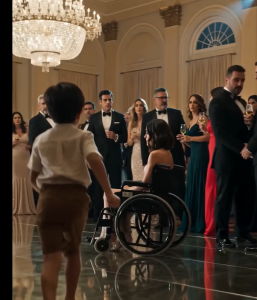
The ballroom glittered as if every chandelier had been lowered from heaven. Crystal light spilled across the polished dance floor, reflecting in champagne glasses, silver plates, and the satin gowns of the guests gathered around the room. Soft music played from the corner, but beneath it ran a quiet tension that no violin could hide. Everyone at the charity gala knew why Lucia Reyes sat near the dance floor in a wheelchair, dressed in a sparkling midnight-blue gown, her hands folded carefully in her lap.
Two years earlier, Lucia had been the heart of every room she entered. She danced at weddings, hosted fundraisers, and laughed with the kind of warmth that made strangers feel welcome. Then a terrible accident changed her life. Doctors told her husband, Mateo, that walking again would be unlikely. Since then, Mateo had guarded her with devotion, standing beside her chair in his black tuxedo like a wall between her and the world’s careless pity.
Lucia tried to smile for the guests, but every song cut deeper than she admitted. The dance floor had once been her favorite place. Now it felt like a mirror showing her everything she had lost.
Then a small figure broke away from the crowd.
A barefoot boy ran across the polished floor, his footsteps soft but quick. He had dark hair, brown shorts, and a light button-up shirt that looked slightly wrinkled from play. His name was Nico, and he was Mateo’s young son from a previous marriage. He had never known Lucia before the wheelchair. To him, she was not a tragedy. She was the woman who read him stories, kissed his forehead, and prayed with him when he was scared.
Guests turned as Nico stopped in front of Lucia and lifted his innocent face. Without embarrassment or hesitation, he held out both hands.
“¿Bailas conmigo?” he asked.
Will you dance with me?
The room seemed to lose its air. A woman in a red dress gasped so sharply that the champagne in her glass trembled. A man beside her stared with his mouth half open. Murmurs swept along the tables like wind through dry leaves. Some guests looked away, afraid for Lucia. Others looked at the boy, wondering whether he understood what he had asked.
Lucia’s lips parted, but no words came. Her eyes filled quickly, not because the question was cruel, but because it was pure. Nico had asked as if standing up were possible, as if the chair did not own her future.
Mateo stepped forward at once. Concern tightened his face. He placed one hand gently on Lucia’s shoulder and looked down at his son.
“Hijo, ella no puede,” he said softly.
Son, she cannot.
Nico did not move. His bare feet stayed planted on the shining floor. He looked first at his father, then at Lucia, and the confidence in his small face made the ballroom quiet in a different way. It was not defiance. It was faith.
“Sí puede,” Nico said. “Dios tiene la última palabra.”
Yes, she can. God has the final word.
No one spoke after that. Even the servers stopped moving. The chandeliers glowed above them, and the music faded into a gentle swell that seemed to come from the walls themselves. Lucia stared at the boy, and something in her expression shifted. For so long, hope had felt dangerous, almost unkind. Hope had made promises her body could not keep. Yet Nico’s voice carried no pressure, no command, and no performance. It carried only belief.
A tear slid down Lucia’s cheek. She looked at Mateo, whose eyes were already wet with fear and love. He wanted to protect her from disappointment. He had watched her try, suffer, and cry where no one could see. He knew the cost of another failed attempt.
But Lucia reached for Nico’s hands.
A whisper moved through the crowd. Nico’s small fingers clasped hers tightly. The camera flashes stopped. The guests leaned forward. On the polished floor, their joined hands reflected beside the curved metal edge of the wheelchair. It was such a simple touch, yet it felt like the whole room had gathered inside it.
Lucia inhaled. Her shoulders trembled. Mateo stepped closer, ready to catch her, but Nico only held her hands and waited.
“Slowly,” Lucia whispered.
Nico nodded. “I’m not letting go.”
With great care, Lucia shifted forward in the chair. The muscles in her legs shook as if remembering an old language. Pain crossed her face, followed by fear. Mateo reached out, but she gave him one small look that stopped him. Not yet. Let me try.
The first movement was almost invisible. Her feet pressed against the floor. Her knees trembled. The guests watched in stunned silence as Lucia pushed herself upward, not gracefully, not easily, but with every ounce of strength she had hidden beneath years of sorrow.
Then she rose.
Mateo stumbled back, his hand covering his mouth. The woman in the red dress began to cry. A glass clinked against a plate somewhere in the room, but no one turned. Every eye was fixed on Lucia Reyes, standing on her own two feet while a barefoot boy held her hands like they were the strongest support in the world.
Lucia gasped. Her body shook, but she remained upright. The wheelchair sat behind her, empty and silent beneath the chandeliers. Nico smiled up at her, not surprised at all.
Lucia looked down at her legs, then at the floor, then at the child in front of her. Her tears fell freely now, bright under the golden light.
“¡Estoy de pie!” she cried.
I’m standing.
The words broke the spell. Guests covered their mouths. Some wept openly. Others whispered prayers. The music swelled, warm and trembling, filling the ballroom with emotion too large for applause. Mateo stood frozen, unable to speak. He had spent two years measuring hope carefully so it would not hurt his wife again. Now hope stood in front of him, holding his son’s hands.
For older guests who had carried private losses of their own, the sight felt personal, a reminder that dignity can survive pain and that love sometimes gives courage back when strength seems gone, when hope feels far away again.
Nico took a tiny step backward. Lucia followed with one small, trembling movement. It was not a full dance, not the graceful turning she once knew, but it was enough. Their hands remained clasped. Her gown shimmered, her knees shook, and every guest understood they were witnessing something that did not need explanation.
Mateo’s face crumpled. One tear rolled down his cheek as he watched the woman he loved stand where grief had told her she never would. He looked at Nico, then at Lucia, and pressed his hand over his heart.
Lucia smiled through tears, still trembling, still afraid, but no longer trapped inside the old verdict spoken over her life. The dance floor glowed beneath crystal light. The wheelchair remained behind her like a chapter closing. Nico’s quiet faith had done what speeches, sympathy, and fear could not do. It reminded everyone in that ballroom that sometimes a miracle begins with a child asking one impossible question.