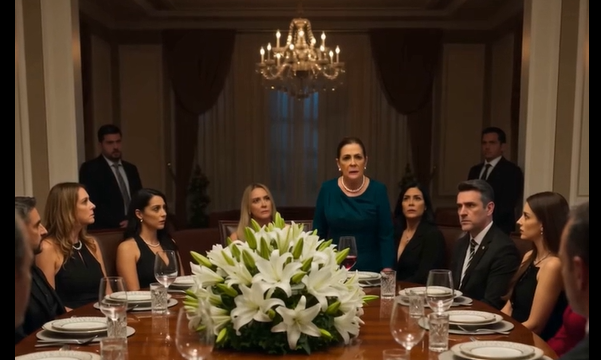
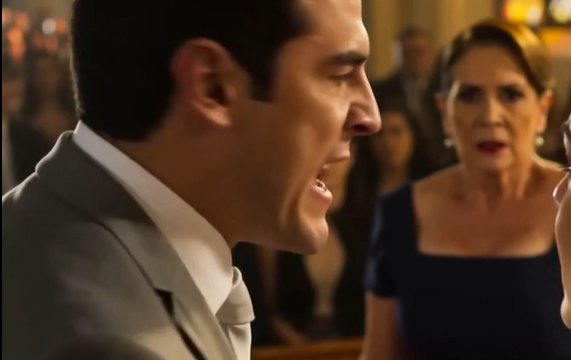
At the entrance of the Grand Aurelia building, everything was designed to look expensive. Gold doors reflected the evening lights, velvet ropes guarded the red carpet, and polished brass lanterns made the sidewalk glow like a movie premiere. Wealthy guests stepped from cars in tailored suits and satin gowns while uniformed employees hurried to open doors and protect the building’s perfect image.
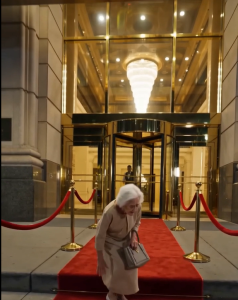
Near the edge of that red carpet, an elderly woman moved slowly with one hand pressed against her chest. Her white hair was neatly brushed, but her beige dress was plain, and the handbag on her arm looked worn from years of use. Each step seemed to cost her strength. She paused beside the velvet rope, breathing heavily, then lowered herself carefully onto the carpet’s edge.
Most people walked around her.
One man in a black vest and bow tie noticed her from inside the entrance. His name was Victor, and he had been warned that an important investor was expected that evening. To him, the old woman looked like a problem, not a person. He rushed through the gold doors with irritation already written across his face.
“¡Levántate de ahí!” he shouted, pointing at her. “Aquí no queremos vagabundos.”
Get up. We do not want homeless people here.
The elderly woman flinched, but she did not answer. Her breath trembled. She gripped her handbag and tried to rise, yet her knees shook. Victor looked embarrassed, not for her, but because guests might see her sitting near the entrance.
Behind him came Rosa, another employee in the same uniform. She carried a bottle of water. Rosa had seen the woman struggling from the lobby. She had not seen a stain on the building’s image. She had seen somebody’s mother, somebody’s grandmother, somebody who needed help.
“Victor, stop,” Rosa said sharply.
He turned on her. “We cannot have people like this sitting on the carpet. Management will blame us.”
Rosa stepped between him and the elderly woman. “Management should blame anyone who treats an old woman like garbage.”
Victor’s eyes narrowed. “You want to lose your job over a stranger?”
Rosa ignored him and crouched beside the woman. Her voice softened. “¡Déjala tranquila! Siéntese aquí conmigo.” Then she added in English, “Please, ma’am, take your time. You are safe here.”
The elderly woman looked up at Rosa with tired eyes. Relief passed over her face like sunlight after rain. Rosa opened the bottle and held it gently, waiting until the woman could drink.
“Gracias, querida,” she whispered. “Muy pocos ayudan así.”
Thank you, dear. Very few people help like this.
Rosa smiled, but her eyes filled with emotion. “My grandmother used to say kindness is only real when no one is applauding.”
Victor scoffed. “Beautiful speech. But if the owner arrives and sees this, you can explain it.”
The old woman heard him. She placed the bottle on her lap and studied Victor calmly. For a moment, her frailty seemed to hide something deeper. Her breathing remained uneven, but her eyes were clear and steady.
“What is your name?” she asked Rosa.
“Rosa Martinez.”
“And you work here?”
“Yes, ma’am. Front entrance service.”
The woman nodded. “And him?”
Victor lifted his chin before Rosa could answer. “Victor Salinas, senior entrance attendant.”
The elderly woman gave a small, tired smile. “Senior in title, perhaps.”
A few guests had stopped nearby. They had heard enough to understand what happened. Some looked ashamed. Others watched Victor with open disapproval. Victor felt the attention and grew more impatient.
“Ma’am,” he said, forcing politeness now, “this is a private building. Unless you have business here, you need to move.”
Rosa stood halfway, angry. “She can rest for one minute.”
“One minute becomes a scene,” Victor muttered.
Then a low engine rolled toward the entrance.
Every head turned. A black luxury car pulled smoothly to the curb, its paint reflecting the gold doors and lights along the walkway. The driver stepped out in a dark suit and opened the rear door with immediate respect. Another man exited from the passenger seat carrying a polished leather briefcase.
Victor straightened instantly. He adjusted his bow tie and stepped toward the car with his professional smile restored. “Good evening, sir. Welcome to the Grand Aurelia.”
The driver did not look at him. Instead, he walked past Victor and approached the elderly woman sitting on the carpet.
“Señora Valdez,” he said softly, “are you all right?”
Victor froze, suddenly aware that everyone had seen his cruelty clearly.
Rosa looked from the driver to the woman. “Señora Valdez?”
The elderly woman breathed in slowly, then accepted Rosa’s arm and stood.
“I am fine now,” she said. “This young woman helped me.”
The man with the briefcase stepped forward. “Your family was worried when you asked us to wait around the corner.”
“I needed to know,” Señora Valdez replied. “A building can shine with gold and still have no heart.”
Victor’s face drained of color. He looked at the car, the driver, the briefcase, and finally the woman he had called homeless. The pieces came together too late.
Rosa whispered, “Ma’am, who are you?”
The elderly woman smiled. “My full name is Beatriz Valdez. My family owns the Grand Aurelia.”
A stunned silence fell across the entrance. Rosa stepped back, overwhelmed, but Beatriz gently held her hand.
“No, dear. Stay beside me with quiet and unmistakable strength.”
The man opened the briefcase. Inside were neat stacks of cash, arranged with official papers and a sealed envelope on top. Rosa gasped and covered her mouth.
Beatriz turned the briefcase toward her. “Esto es para ti. Tu bondad vale más que el dinero.”
This is for you. Your kindness is worth more than money.
Rosa shook her head, tears rising. “I cannot accept this. I only gave you water.”
“You gave me dignity,” Beatriz said. “That is never a small thing.”
Victor stared as if the ground had vanished beneath him. His arrogance had cost him more than a reward. It had revealed exactly who he was when he believed a person had nothing to offer him.
Beatriz looked at him, not with anger, but with disappointment. “Mr. Salinas, you protected the carpet and forgot the human being sitting on it. That is not service. That is pride wearing a uniform.”
Victor opened his mouth, but no apology sounded strong enough. The guests were watching. The employees were watching. Rosa was crying quietly beside the woman he had insulted.
Beatriz handed Rosa the sealed envelope. “This includes a promotion offer, paid training, and a scholarship fund in your grandmother’s name, if you will allow it.”
Rosa sobbed then, not from greed, but from the shock of being seen. She hugged Beatriz carefully, mindful of her frailty.
The luxury lights still glittered. The gold doors still shone. But that evening, everyone at the Grand Aurelia learned that elegance is not found in carpets, cars, or polished entrances. It is found in the way a person treats someone who appears to have nothing. Victor had looked at an elderly woman and seen an inconvenience. Rosa had looked at the same woman and seen a human being. In the end, kindness saw what judgment missed.