The auto repair shop was alive with the sounds of a workday: the hum of machinery, the clink of metal, and the echo of tools being placed into drawers. Fluorescent lights reflected off the concrete floor, while a car rested high above the ground on a hydraulic lift. Several mechanics in blue uniforms had been working moments earlier, but now they stood still, watching an unexpected scene.
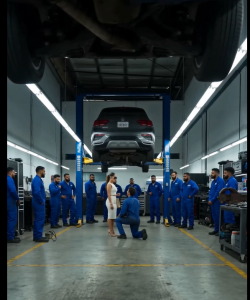
In the center of the shop, a man in blue coveralls lowered himself onto one knee.
His gray T-shirt was visible beneath the work clothes, and a stained rag rested over one shoulder. Grease marked his hands and left faint streaks across his face, evidence of the work he had been doing all day. He did not look polished or wealthy. He looked exactly like what he was at that moment: a mechanic who had spent hours working with engines, tools, and machinery.
Yet there was nothing uncertain about the way he looked at Valeria.
She stood in front of him wearing a white sleeveless dress with a gold belt, beige heels, statement earrings, and oversized sunglasses. A beige designer handbag hung from her hand. Against the gritty surroundings of the repair shop, she looked almost untouched by the place.
The mechanic raised a simple silver ring.
“Valeria,” he said, his voice steady but hopeful. “Do you want to marry me?”
For a moment, the garage seemed to become still.
The other mechanics watched from a distance. No one spoke. The man remained on one knee, holding the ring toward the woman he apparently believed might become his wife.
Valeria stared down at him.
Her eyes were hidden behind the large sunglasses, but the change in her expression was impossible to miss. Instead of surprise, tenderness, or emotion, her face tightened with disgust. Her attention moved from his face to his stained coveralls and then to his grease-covered hands.
The silence quickly became uncomfortable.
“Marry you?” she said.
Her tone carried no affection.
She lifted one hand dismissively, as though the proposal itself offended her.
“You’re a dirty mechanic. Look at yourself. You’re nobody. You’re worth nothing.”
The words landed harder than any sound in the shop.
The mechanics in the background did not laugh. They did not move. They simply watched silently as Valeria publicly reduced the man’s entire value to the appearance of his work clothes and the profession that had put grease on his hands.
The man stayed where he was.
He did not beg her to reconsider. He did not argue. He did not lower his head in shame. He simply absorbed the insult while holding the ring between his fingers.
For a brief second, it appeared as though the proposal had ended with nothing but humiliation.
Then something changed.
His grip on the ring became steadier.
The hurt in his expression did not turn into anger. Instead, a small, knowing smile appeared on his face, the kind of expression that suggested Valeria had just revealed far more about herself than she realized.
He slowly lowered the ring.
“This,” he said calmly, glancing around the active repair shop, “is just one of my shops.”
Valeria’s posture changed.
The confidence that had shaped every cruel word began to disappear. Her lips parted slightly, and although her eyes remained hidden behind the sunglasses, the shock on her face was clear.
The handbag at her side suddenly seemed frozen in place.
Behind them, the workers began exchanging quiet looks.
The mechanic had not dressed up to impress her. He had not staged the proposal in some expensive restaurant or luxury hotel. He had asked an important question while standing in the place where he actually worked, dressed exactly as he worked every day.
And Valeria had answered based on what she saw.
But the man was not finished.
Still kneeling, he looked at her with a confidence that no expensive suit could have created.
“I have ten,” he continued. “And I’m never going to stop working.”
The meaning of his words settled over the room.
He was not ashamed of being a mechanic. He was not pretending that hard work was something temporary that he planned to abandon after becoming successful. The grease on his hands was not proof that he had failed. It was proof that he continued to participate in the work that had helped build what he owned.
Valeria had seen dirty coveralls and decided he was nobody.
What she had failed to see was the person inside them.
The man’s revelation was not simply that he had money or that he owned several businesses. The deeper truth was that his sense of worth had never depended on looking wealthy. He knew what he had built, and he knew that honest work did not become less respectable just because someone else considered it beneath them.
The mechanics nearby remained silent witnesses.
They had likely seen him work beside them, get his hands dirty, and treat the shop as a place worth respecting. Now they had also seen the woman he loved dismiss that same work as proof that he had no value.
The proposal had revealed something neither a romantic dinner nor an expensive gift could have exposed so clearly.
It showed how Valeria measured people.
Her rejection had not been based on whether she loved him, whether they shared the same future, or whether marriage felt right. She had attacked his dignity. She had called him nobody. She had told him he was worth nothing because he looked like a working mechanic in an auto shop.
After his revelation, there was no dramatic celebration.
There was no second proposal.
There was no opportunity for her to change her answer simply because she had discovered that the man she insulted owned ten shops.
The mechanic looked down at the silver ring in his hand.
Then, with deliberate calm, he closed his fingers around it.
He reached toward his shirt pocket, tucked the ring away, and buttoned the pocket shut.
The small gesture said everything.
The proposal was over.
Valeria stood motionless, her earlier arrogance replaced by shock and regret. The same shop she had treated as evidence of his low status now represented something entirely different. The raised vehicle, the tool cabinets, the stained concrete, and the men in blue uniforms were no longer symbols of failure. They were part of a business the mechanic had helped build and continued to serve with his own hands.
Nothing about him had changed during those fifteen seconds.
He was still wearing the same coveralls. His face still carried grease. The rag remained over his shoulder. He was still a mechanic.
Only Valeria’s understanding had changed.
And by then, it was too late.
The moment offered a simple reminder that appearances can hide more than wealth. They can hide discipline, ownership, sacrifice, pride, and years of effort. A person’s job title, clothing, or stained hands cannot measure character or value.
The mechanic had asked Valeria to share his life.
Her answer showed him how she viewed his.
So he put the ring away, stood with his dignity intact, and let the proposal end exactly where her contempt had taken it.