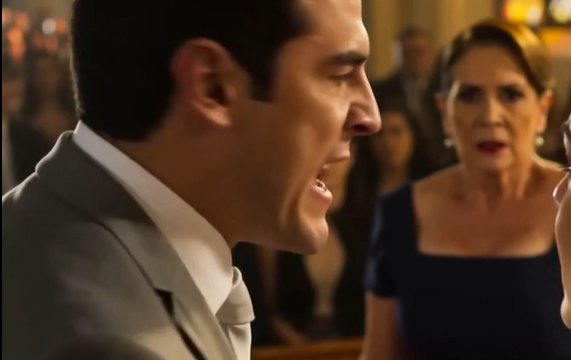
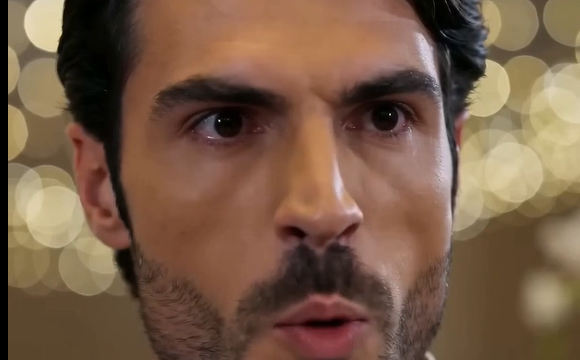
The restaurant had been chosen for romance. Soft candlelight moved across white tablecloths, wine glasses, and silverware arranged with precision. Around the couple, other diners spoke in low voices while servers passed quietly between tables. Everything about the room suggested elegance, privacy, and celebration. Yet at one table, the evening was beginning to fracture.

Across from each other sat a dark-haired man in a dark suit jacket and a woman wearing a deep green off-the-shoulder dress with gold earrings. Her hair was tied back neatly, and her expression was controlled. His was anything but. He leaned toward her over the table, his jaw tight and his eyes burning with anger. The untouched wine between them seemed symbolic, as though the dinner had stopped before it truly began.
“I saw you with him. Don’t deny it. I always knew you were cheating on me,” he said in Spanish, loud enough for nearby diners to hear.
A few heads turned. Silverware paused against plates. The woman did not raise her voice. She looked directly at him and answered with a warning that was simple and firm.
“Lower your voice.”
Her composure only seemed to make him angrier. Instead of noticing the discomfort spreading through the restaurant, he leaned closer. The candle between them flickered as his movement disturbed the air.
“Answer me!” he demanded.
The surrounding conversation faded. People who had been trying not to stare were now aware that something was wrong. The man was no longer having a private disagreement. He had turned suspicion into a public accusation, and he appeared determined to force an answer before considering whether his conclusion might be wrong.
Then he crossed another line.
Reaching across the table, he grabbed her arm.
The contact lasted only a moment, but it changed the entire meaning of the argument. The woman did not scream or panic. She became still. Her face showed something colder and more painful than fear. Until that instant, she had been dealing with an accusation. Now she was confronting the fact that the man sitting across from her had allowed his anger to become physical.
Soft gasps came from nearby tables. Fabric shifted as diners turned in their chairs. The man released her, but the damage had already been done.
She looked at him in silence.
There was no dramatic outburst. No pleading. No attempt to match his volume. Instead, her eyes carried the unmistakable disappointment of someone who had just learned something painful about the person she trusted.
Then she reached for her handbag.
The man watched as she opened the small clutch with deliberate calm. From inside, she removed a printed photo identification document. She placed it on the white tablecloth beside the candle, where the warm light fell across the photograph and printed information.
For the first time that evening, the man stopped talking.
His eyes moved toward the document.
The anger drained from his face.
The woman finally gave him the answer he had been demanding.
“He was my brother. I found him today.”
The words landed harder than any shouted response could have.
The man stared at the identification, then at her, then back at the paper. His certainty collapsed in seconds. What he had interpreted as betrayal had been something entirely different. The person he had seen her with was not a secret lover. He was her brother, someone she had apparently only just found that day.
The revelation transformed every moment that had come before it.
His accusation had been wrong. His public scene had been unnecessary. His demand for an immediate explanation had been driven by jealousy rather than trust. Most painfully, he had acted before allowing her the dignity of telling him the truth in her own way.
She lifted the identification briefly, making sure there could be no confusion. The restaurant around them remained quiet. No one needed to comment. The document on the table and the shock on the man’s face said enough.
He looked emotionally shaken now, the fury replaced by horror at what he had done. Perhaps he wanted to apologize. Perhaps he wanted to explain that jealousy had overwhelmed him. Perhaps he wanted to take back the shouting, the accusation, and the moment he reached across the table.
But some moments cannot be recalled simply because regret arrives afterward.
The woman rose from her chair.
She did not appear triumphant. There was no satisfaction in proving him wrong. Her expression suggested that the truth had cost her something, too. This should have been a meaningful day. Finding a brother could have carried joy, confusion, relief, or countless complicated emotions. Instead, the moment had become tangled with humiliation and distrust during what should have been a private dinner.
Standing beside the table, she looked at the man one last time.
“The accusation doesn’t hurt me,” she told him. “What hurts is that you put your hands on me.”
Her words clarified what mattered most.
The problem was no longer simply that he had misunderstood what he saw. People can make mistakes. People can feel jealous, frightened, or insecure. Relationships sometimes survive painful misunderstandings when both people are willing to listen and repair the damage. But his behavior had revealed something larger than a mistaken assumption. He had decided that his anger gave him permission to intimidate her physically.
She refused to treat that as a small detail.
Then she walked away.
Her footsteps faded through the restaurant as she moved beyond the table and out of view. The diners slowly began to breathe again, though the tension remained. The man stayed seated beneath the warm candlelight, alone now, staring at the identification document and the empty chair across from him.
Only minutes earlier, he had believed he was confronting betrayal. Now he was facing the consequences of his own actions.
The scene offers a quiet reminder about trust. Suspicion can feel convincing when emotions are intense, especially when someone believes they have seen proof with their own eyes. But what appears obvious may still be incomplete. Asking questions is different from making accusations. Expressing hurt is different from demanding control. And anger never creates a right to use physical intimidation.
The woman’s final decision was not presented as revenge. She did not humiliate him in return or prolong the confrontation for the benefit of the watching crowd. She showed him the truth, named the boundary he had crossed, and removed herself from the situation.
That restraint made her departure more powerful.
For the man, the empty chair became the clearest consequence. He had wanted an answer, and he received one. Yet by the time the truth arrived, his behavior had already changed the relationship. The identification on the table proved that his suspicion was wrong, but it could not undo the moment when distrust became disrespect.
In the end, the most shocking truth was not simply who the other man was. It was what jealousy had revealed about the man at the table. One impulsive act turned a misunderstanding into a breaking point, leaving him alone with the evidence he should have waited to understand and the silence of someone who had decided that dignity mattered more than staying.