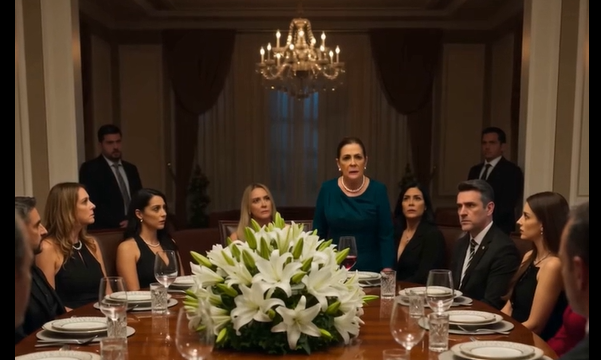
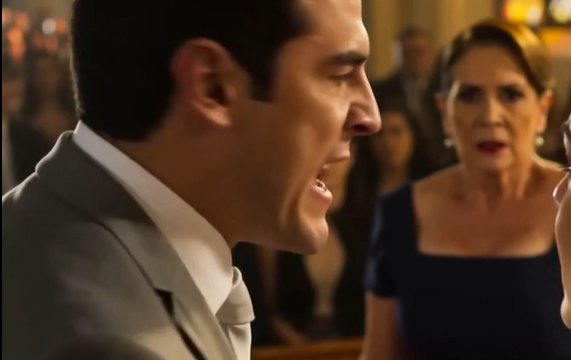
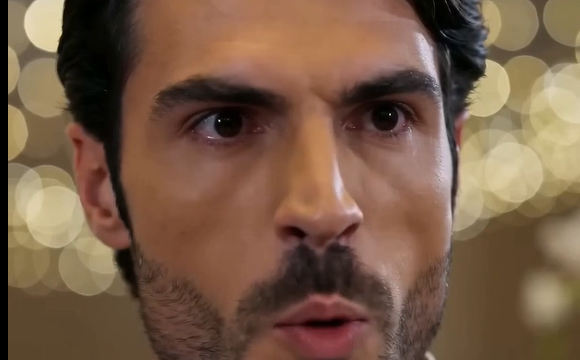
The dining room looked flawless. A crystal chandelier hung above a long wooden table covered with a white cloth. Candles flickered beside polished wine glasses, fine plates, silverware, and generous platters of food. Everyone had dressed, and from a distance, the scene might have looked peaceful. Yet beneath the light and formal setting, tension pressed down on the room like a weight.
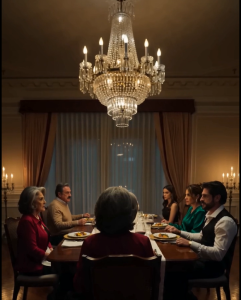
The wife sat beside her husband in an emerald green satin dress, her brown hair pinned loosely behind her head. Silver hoop earrings caught the candlelight whenever she turned. She looked composed, but there was pain in her eyes, the kind that comes from carrying a truth alone for too long. Around the table, relatives tried to continue eating as though nothing unusual was happening. Their movements were small and cautious. Forks touched plates. Glasses shifted. No one seemed willing to meet her gaze for very long.
Her husband leaned toward her before anyone could acknowledge the tension. His dark hair was neatly styled, his beard carefully groomed, and his white shirt and black vest made him look as polished as the room itself. But his expression was anxious.
“No hagas una escena,” he whispered.
Don’t make a scene.
The words were quiet, but the message behind them was unmistakable. He was not asking how she felt. He was not offering an explanation. He was asking her to stay silent so the family could continue pretending everything was fine.
She turned toward him slowly.
“¿Escena? Escena es fingir que no pasa nada.”
A scene? A scene is pretending nothing is happening.
Her voice was controlled, but there was no hesitation in it. The pain she had been swallowing was turning into refusal. She would no longer protect appearances at the cost of her own dignity.
Across the table, her mother-in-law watched closely. The older woman sat upright in a red jacket over a black top, a pearl necklace resting against her collar. Her voluminous gray hair framed a stern face. She said nothing at first, but her pressed lips and hard stare made her position clear. She was waiting for the wife to stop.
The father-in-law did not wait as long. Wearing a tan sweater over a collared shirt, he leaned forward with the authority of someone accustomed to being obeyed.
“Respeta a tu esposo,” he said.
Respect your husband.
The command landed heavily in the room.
For a moment, the wife simply looked at him. Then she turned back toward her husband. His confidence was beginning to disappear. He had expected her to stay quiet. He had expected the familiar pressure of family expectations to keep her seated and obedient. Instead, she finally said what everyone seemed desperate to avoid.
“Yo lo respeté… aunque sabía que me era infiel.”
I respected him… even though I knew he was unfaithful to me.
The room changed instantly.
A relative stopped moving her fork. Another man at the table shifted uncomfortably in his chair. Someone drew a sharp breath. The husband’s face tightened. He did not deny the accusation. He did not ask what she meant. He simply looked trapped by the truth she had finally spoken aloud.
The mother-in-law reacted first.
“¡Basta!”
Enough!
Her voice cut through the room so sharply that a glass rattled against the table. It was not a question. It was an attempt to end the conversation before more could be revealed.
But the wife had already crossed the point where silence felt possible.
She turned directly toward her mother-in-law. Her expression was no longer simply hurt. It was steady, clear, and deeply disappointed.
“Lo peor no es eso, es que usted ya lo sabía.”
The worst part isn’t that. It’s that you already knew.
This time, no one interrupted.
The accusation was calm, which made it even harder to escape. The wife was not shouting or throwing accusations wildly around the table. She was stating what she knew, looking directly at the woman who had apparently helped preserve the illusion of a happy marriage.
The mother-in-law stiffened.
The father-in-law’s earlier authority seemed to weaken. The husband looked increasingly anxious. The other relatives remained silent, their discomfort now impossible to hide.
The wife pushed her chair back.
The wooden legs scraped across the floor, a harsh sound in the suddenly quiet dining room. The emerald satin of her dress caught the candlelight as she stood. Every face turned toward her.
For most of the evening, she had been expected to sit there and play her role. She was supposed to smile, eat dinner, show respect, and protect the family from embarrassment. Her husband had tried to stop her before anyone noticed. Her father-in-law had ordered her to respect the man who had betrayed her. Her mother-in-law had tried to silence her once the truth became uncomfortable.
Now she stood while the rest of them remained seated.
There was nothing dramatic about her posture. She did not need to slam her hands on the table or raise her voice. The power of the moment came from the simple fact that she was no longer willing to participate in the performance.
She looked at her husband first.
The man who had asked her not to make a scene could no longer control the conversation. His anxious expression revealed how quickly his confidence had collapsed once the truth became public.
Then she looked at his mother.
The older woman who had shouted “Enough” had no command left strong enough to erase what had been said.
Finally, the wife looked across the entire table.
“No solo me traicionó él, también su familia.”
Not only did he betray me, but his family did too.
Her final words settled over the table.
No one answered.
The candles continued flickering. The food remained untouched. The chandelier still shone over the carefully arranged dinner, but the appearance of a united family had been broken. The silence was no longer polite. It was heavy with guilt, shock, and the recognition that the wife had been carrying more than the pain of an unfaithful husband.
She had also been surrounded by people who knew enough to help maintain the lie.
That realization was what made the betrayal feel larger than one marriage. Her husband’s actions had wounded her, but the family’s silence had left her isolated inside a room full of people who were supposed to treat her as one of their own.
The scene ended not with shouting, revenge, or chaos, but with a table full of frozen faces.
The husband sat speechless. The mother-in-law remained rigid. The father-in-law, so commanding moments earlier, had nothing more to say. The other relatives stared down or looked away, unable to escape the truth now sitting openly among them.
And the wife remained standing.
She had entered the dinner carrying a secret that everyone wanted hidden. She ended it by refusing to protect the people who had expected her to suffer quietly for the sake of appearances.
Sometimes betrayal is not only about what one person does behind closed doors. Sometimes it is also about the people who know, stay silent, and expect the injured person to keep smiling.
That night, the wife finally stopped pretending.