The construction site looked nothing like the polished places she preferred. Under hard daylight, unfinished concrete buildings rose behind a pile of gravel, their raw walls exposed and columns waiting for the work that would eventually make them complete. Tools lay across the dusty ground, and the air carried machinery, distant hammering, and wind moving through cement dust. It was a place built on effort, patience, and physical labor, but the woman stepping carefully across the rough ground in high heels seemed to notice only the dirt.
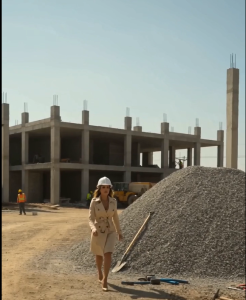
She wore a beige trench coat that looked too refined for the setting. Each step over the gravel appeared to irritate her more. Her heels sank into the uneven surface as she approached a young man standing near the unfinished structure. He wore a blue denim shirt and a white hard hat. His hands were dusty, his clothes showed the evidence of a long workday, and there was nothing flashy about him. Still, he stood calmly, without apology, as if he belonged exactly where he was.
The woman stopped in front of him and studied him from head to toe. Her expression changed as she took in the hard hat, work clothes, and dust on his hands. What began as confusion quickly hardened into disappointment.
“Wait,” she said, staring at him. “Weren’t you an engineer?”
The young man did not try to impress her or hide behind a title.
“No,” he answered.
For a moment, the construction sounds seemed to fade behind them. The woman’s eyes narrowed, while the young man glanced down briefly. It was not the look of someone ashamed of what he did. Instead, it seemed like the quiet pause of a person preparing to say something honest.
Dust caught the sunlight across his white hard hat. He raised his eyes and met her stare.
“I’m a bricklayer,” he said.
His voice was calm. There was no embarrassment, no attempt to soften the truth, and no suggestion that he believed his work made him less worthy than anyone else. He said it with the pride of someone who knew what his labor meant.
The woman reacted as though he had admitted something disgraceful.
Her face tightened, and she shifted in her heels. Behind her, the unfinished building blurred into gray concrete and open space, while her expression made her judgment unmistakable.
“Then you lied to me,” she said coldly. “I don’t date laborers.”
The words landed harder than the clank of tools in the distance. What bothered her was not that he had harmed someone, cheated anyone, or refused to work. Her rejection came from the kind of work he did with his hands. To her, his job was enough to define his value.
The young man remained still.
He could have argued or tried to defend himself by listing every difficult task he had completed at the site. Instead, he stood quietly, absorbing the insult without surrendering his dignity.
Then boots crunched across the gravel.
An older man stepped into view wearing a yellow hard hat and a reflective work jacket that flashed in the sunlight. His presence immediately changed the tension. He moved beside the young man with the confidence of someone who understood the project, the workers, and the effort behind every wall rising around them.
He faced the woman directly.
“Ma’am,” he said firmly, “he’s the one who built this project.”
The statement stopped her.
The unfinished structure behind them suddenly carried a different meaning. The raw concrete was no longer evidence of a low-status job. It was evidence of skill, labor, responsibility, and creation. Every wall represented hours of physical effort. Every column had been shaped by people willing to work through dust, noise, heat, and exhaustion so others could one day enter a finished building and admire the result.
The older man did not need a long speech. His defense was powerful because it was specific. The young man was not merely standing at a construction site. He had helped raise it. The work the woman dismissed was the work making the project possible.
For the first time, she had no quick response.
The young man looked at her again. Any hurt in his expression had settled into something stronger. His shoulders were straight. His eyes were steady. He was still wearing the dusty denim shirt and white hard hat she had judged moments earlier, but now those details seemed less like symbols of status and more like proof of who he was.
He was a man who worked, built, and understood why he did it.
“And with this,” he said, “I support my family.”
There was no anger in his final statement. He did not insult her in return or try to humiliate her. He simply stated the truth with controlled pride.
For many people, a job is not a symbol meant to impress strangers. It is how groceries are bought, rent is paid, children are cared for, parents are supported, and a household keeps moving forward. Work can be exhausting, dirty, repetitive, or physically demanding and still carry enormous dignity. The young man’s hands were dusty because he used them to earn an honest living, not because he had failed.
The older man remained beside him, his silent support reinforcing the message. Around them, the construction site continued its ordinary rhythm. Machinery hummed. Tools struck concrete. Wind moved through the dust. Somewhere nearby, another worker crossed the gravel in heavy boots.
The woman had arrived seeing the environment as something beneath her. She looked at unfinished walls and dirty ground and assumed the people working there deserved less admiration than someone with a polished title. Her disappointment came from an image she had created, not from the young man’s character.
The young man had not pretended to be ashamed. When asked directly, he told the truth. When rejected, he did not beg for acceptance. When insulted, he did not lose control. And when given the chance to explain what his work meant, he spoke about his family rather than himself.
The older man’s defense exposed the weakness in the woman’s judgment, but the young man’s final words completed the lesson. A person’s worth cannot be measured by whether a job keeps clothes clean, sounds impressive at dinner, or fits someone else’s idea of success. What matters is the honesty, responsibility, and purpose behind the work.
He stood tall beside the concrete structure he had helped build, wearing the hard hat that had caused her to look down on him moments earlier. Behind him rose the result of real labor. Beside him stood a man who respected that labor. In front of him was someone forced to confront the assumptions she had made.
The scene ended not with revenge, but with dignity.
The young man had been judged for being a bricklayer, yet he left the moment with something more valuable than a prestigious title. He had pride in his work, loyalty to his family, and the confidence to stand behind an honest life. The construction site remained dusty and unfinished, but the message was complete: there is no shame in building with your hands when those hands are building a future.