The alley looked like a place the city had forgotten. Gray daylight hung over narrow brick walls darkened by rain, while sagging wires crossed the overcast sky above puddles, torn posters, trash bags, and patches of thick brown mud. Water dripped from rusted pipes and broken gutters. Beyond the cramped neighborhood, distant traffic moved through another world, but inside the passage, every sound felt muted by exhaustion.
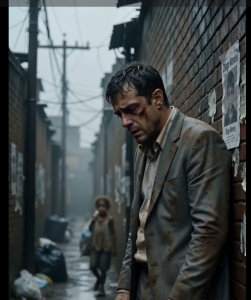
Near one wall stood a father who looked as though he had not slept in days. His gray suit was stained at the knees and cuffs. His white shirt was wrinkled, his face unshaven, and his eyes red from worry. In one trembling hand, he held several missing child flyers. Each showed the same photograph and the same name beneath it: Diego Morales.
He had carried those flyers through streets, markets, and alleys, asking strangers the same painful question again and again. Had anyone seen his son?
No answer had brought Diego home.
Now he pulled a strip of tape from a small roll and pressed another flyer against the damp brick. The paper curled from the wet surface. He smoothed it with shaking fingers, then pressed each corner firmly into place, as though keeping the poster there might keep his hope from falling apart.
The tape tore sharply in the quiet alley.
Mud shifted beneath his shoes.
A faint wind lifted the edge of another flyer in his hand.
He stared at Diego’s photograph for one extra second before lowering his eyes. The boy’s face had become both his reason to keep moving and the image that haunted every hour he could not find him.
Then came the soft clatter of plastic bottles.
A young girl entered the alley carrying a large sack of recyclables over one shoulder. Her clothes were worn and ragged, and the sack looked far too heavy for her small frame. Empty bottles knocked together as she walked carefully around puddles. At first, she paid little attention to the exhausted man by the wall. Hardship was visible everywhere in the neighborhood, so the exhausted stranger drew little attention.
But the photograph on the poster caught her attention.
She slowed.
The father did not notice. He was busy pressing the final strip of tape against the brick.
The girl stepped closer and studied the boy’s face.
Her casual curiosity disappeared.
Recognition flashed across her expression.
She shifted the sack and looked from the picture to the father, then back again, making sure she was not mistaken.
“Sir, what are you doing?” she asked.
The father turned slightly, too tired to understand why she sounded concerned.
Then she pointed toward the poster.
“But, isn’t this the little brother my mom found?”
For a second, the alley seemed to lose every sound.
The dripping water disappeared from his awareness.
The father froze with several flyers still clutched in his hand. His eyes widened, and his mouth opened without producing a word. The damp papers slipped lower between his fingers, their corners bending as his grip weakened.
He had heard false leads before and followed rumors that ended in disappointment. He had rushed across neighborhoods because someone thought they saw Diego. Every mistake had taken something from him.
But this was different.
The girl had not asked whether the child was missing.
She had spoken as if she knew him.
As if someone had found him.
Hope struck the father so suddenly that it almost looked like fear.
He dropped to his knees in the mud.
Dirty water splashed onto his stained suit, but he did not notice. Still holding the flyers in one hand, he gently placed his other hands on the girl’s shoulders, careful not to frighten her. His face showed panic, disbelief, exhaustion, and a hope he had almost stopped allowing himself to feel.
“What did you just say?” he asked.
The girl looked at him quietly. She did not seem to understand the full weight of what she had said. To her, it was a simple connection between a face on a wall and a child her mother had encountered. To him, it was a doorway out of a nightmare.
She glanced deeper into the alley.
The narrow path curved between rain-darkened brick walls and disappeared beyond bags, old containers, and sagging lines. She adjusted the heavy sack of bottles again. Plastic crackled against plastic as she lifted one arm and pointed subtly toward the path.
The father followed her gesture with his eyes.
He searched her face for hesitation.
Her expression held the calm certainty of a child stating something obvious.
For the first time in days, his breathing changed. It was still fast, still frightened, but no longer empty. The possibility that Diego might be nearby moved through him like a sudden current.
The girl turned toward the narrow passage.
“Sir, follow me.”
Those three words gave him more strength than anything had since his son disappeared.
He pushed himself upright too quickly and nearly lost his footing. One shoe slid through the mud, and he threw out an arm to steady himself against the wall. The missing flyers crushed slightly against his chest as he gathered them close.
Then he followed.
The girl walked ahead, bottles rattling in the sack with every step. The father stayed only a few feet behind, moving through puddles without caring what happened to his clothes. Mud splashed his pants. Water soaked his shoes. His heart seemed to race faster with every corner they approached.
He did not know what waited beyond the alley.
He did not know whether the girl had understood the poster correctly, whether the child her mother found was truly Diego, or what condition the boy might be in.
But certainty was not what kept him moving.
Hope was.
Moments earlier, he had pressed another desperate poster onto a wet wall, preparing to continue a search with no promise of an answer. Now a child carrying discarded bottles might be leading him toward the person he loved most.
The father looked down at the flyers pressed against his chest. Diego’s name remained visible across the top sheet.
Diego Morales.
He had repeated that name to strangers until his voice became hoarse. He had printed it on paper, carried it through rain, and refused to stop asking questions when exhaustion told him to surrender.
Now he whispered the name again, but this time it sounded different.
Not like a plea.
Like a promise.
Ahead, the girl moved deeper into the muddy path and glanced back once to make sure he was still following.
He was.
His face was still worn, his suit still filthy, and fear had not disappeared. Yet something fragile had returned to his eyes.
For the first time since the search began, he was not moving randomly between leads.
He was following someone who believed she knew where Diego was.
Their footsteps sloshed through the mud as the bottles clattered softly in the sack. The alley remained gray, poor, and unforgiving, but it no longer felt completely hopeless.
Somewhere beyond the next corner, there might finally be an answer.
And the father hurried after the girl, clutching his son’s flyers to his heart.





