At the center of the ballroom, crystal chandeliers poured warm light across white tablecloths, polished glassware, and hundreds of carefully dressed guests. Then a small boy in a black tuxedo came running through the crowd, and within seconds, the entire gala changed.
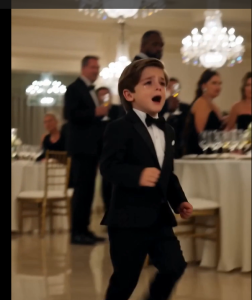
His bow tie sat slightly crooked, tears streaked his cheeks, and his breathing came in broken bursts as he pushed between chairs and startled guests.
Then he saw her.
“Mommy!” he cried.
Heads turned. Conversations stopped. Even the nearest servers paused.
The boy ran straight toward a catering worker standing beside one of the tables. She wore a simple white button-down shirt and black skirt, her hair pulled into a neat bun. In one hand she balanced a tray filled with champagne glasses. Before she could react, the boy wrapped both arms around her waist and buried his face against her shirt.
The glasses trembled and clinked together.
For a second, the woman froze.
She looked down at the child with complete confusion. Her free hand hovered above his back, uncertain whether to comfort him or step away. But the boy only held tighter, sobbing as though he had finally reached someone he had feared losing forever.
“No, you came back!” he said through tears. “I knew you would come back.”
The worker’s expression changed. Shock remained in her eyes, but compassion overcame hesitation. Carefully keeping the tray level with one hand, she placed the other around the boy and held him.
The room filled with whispers.
Some guests exchanged puzzled looks. Others stared at the child, then at the worker, trying to understand why a young boy dressed like a member of a wealthy family was clinging desperately to a woman serving drinks.
Before anyone could ask, a woman in a sparkling strapless gown stepped forward.
Diamonds flashed at her neck. Her heels struck the floor with sharp authority, and her face tightened with visible disgust as she looked at the embrace.
“Get him away from her!” she ordered.
The command was cold enough to silence the nearby guests.
The catering worker stiffened, but the boy refused to let go. He pressed his wet face into her shoulder and cried even harder.
“No!” he shouted. “She’s my mommy!”
The woman in the sequined gown stared at him as though he had said something impossible.
The worker looked stunned as well. Her hand remained on the boy’s back, but her eyes moved quickly across the crowd, searching for some explanation.
Then an older man approached.
He studied the boy first.
Then he looked at the catering worker.
Something about her face seemed to disturb him.
He took another step forward, his attention fixed on the child clinging to the woman.
“What did you call her?” he asked.
The boy slowly lifted his face from the worker’s shoulder. Tears covered his cheeks. His small hands still gripped the fabric of her white shirt as though releasing her might make her disappear again.
“Mommy,” he answered softly.
The single word seemed to stop the older man completely.
His eyes moved from the child to the worker once more.
The champagne tray trembled slightly in her hand, sending another soft clink through the silence. She did not speak. She seemed just as confused as everyone watching.
But the wealthy man was no longer confused.
Recognition arrived across his face slowly, then all at once.
His eyes widened.
His mouth parted.
The seriousness that had defined him seconds earlier disappeared beneath something far deeper: shock, grief, and realization.
“Clara,” he whispered.
A wave of gasps moved through the ballroom.
The catering worker went completely still.
The boy remained wrapped around her, unaware of the full meaning behind the name. To him, the moment was simple. He had found the woman he believed was his mother, and no command from an angry adult could make him release her.
For everyone else, the name changed everything.
The arrogant woman who had demanded that the child be pulled away no longer looked commanding. Her confidence faltered as she turned toward the wealthy man, clearly realizing that he recognized the worker.
No one wanted to interrupt what appeared to be the beginning of a truth hidden far longer than anyone in that room understood.
The worker’s face showed no triumph.
She did not suddenly claim a place among the wealthy guests. She did not challenge the woman who had treated her like someone unworthy of being embraced by the boy. Instead, she simply stood there, overwhelmed, holding a child who had reached for her with absolute certainty.
That made the moment even more powerful.
The guests wore expensive clothes. The tables glittered with polished glass. The evening reflected a world in which appearances seemed to reveal exactly where everyone belonged.
Yet the boy had ignored all of it.
He did not care about the worker’s uniform.
He did not care that she carried champagne instead of wearing diamonds.
He did not care whether anyone approved.
He had seen her and called her “Mommy.”
Now the wealthy man had called her “Clara.”
The older man stared at Clara as though he were looking at someone he had once known, lost, or believed he would never see again. His shock suggested history, but the ballroom had not yet heard that history. The child’s certainty suggested an even deeper connection, but no explanation had yet been given.
That unanswered space left everyone stunned.
For the guests watching, the contrast was impossible to ignore. Minutes earlier, Clara had blended into the background as another worker quietly doing her job. Now every eye followed her. The shift did not come from a change in clothing, wealth, or position. It came from recognition. The boy’s grief had exposed a bond that appearances could not explain, while the older man’s whispered name suggested a past suddenly returning to the present. Even the smallest sounds seemed louder in the silence: the boy’s uneven breathing, the faint rattle of glass against glass, and the cautious movement of guests turning for a better view. Nobody there could honestly pretend this was ordinary anymore.
Clara’s tray shook again.
The boy tightened his arms around her.
The older man remained fixed in place, unable to hide the recognition on his face.
And the woman in the sequined gown, who had tried to separate them moments earlier, could only watch as control of the room slipped completely away from her.
The truth had not been fully revealed, but something undeniable had already surfaced.
A child had found the woman he believed was his mother.
A powerful man had recognized her by name.
And Clara, standing beneath the chandeliers in a simple catering uniform, had suddenly become the one person every guest wanted to understand.
As the music swelled and stunned whispers spread across the ballroom, the wealthy man continued staring at her, shaken by whatever memory had returned.
Clara remained frozen, the champagne tray trembling in one hand and the crying boy held close with the other.
Then the scene cut to black, leaving one question hanging over the silent gala:
Who was Clara, and why did both the child and the wealthy man seem to know her?





