The last light of the day spilled across the school’s outdoor concrete staircase, turning the gray steps gold and casting long shadows from the metal railings. Students moved through the walkway with backpacks slung over their shoulders, jackets tied around their waists, and phones glowing in their hands. From a distance, it looked like any ordinary afternoon at dismissal, the kind of scene that would normally disappear into memory before dinner. But near the top of the stairs, something was happening that made the air feel colder than the fading sun.
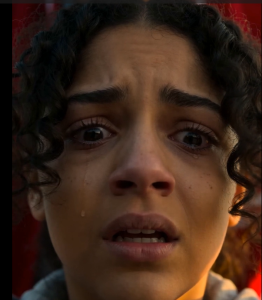
A young man with short blond hair stood beside a black manual wheelchair. His red and white varsity jacket caught the sunset, making him easy to notice among the students gathering below. He leaned forward, invading the space of the young woman seated in the chair. She had dark curly hair, a blue denim jacket over a gray hoodie, and a frightened expression that she could no longer hide. Her shoulders were stiff. Her hands stayed close to the wheels. Every part of her body seemed to understand the danger before anyone said another word.
The young man blocked much of the warm light behind him. He looked down at her with a cold expression and spoke as if what he wanted was simple.
“Go ahead.”
The words were quiet, but they carried.
The girl’s right hand rested on the wheelchair handrim. Her fingers trembled against the metal, yet she did not move. The chair remained still on the concrete landing. Around them came the usual distant sounds of a schoolyard, but they now seemed strangely far away: shoes scraping pavement, nervous whispers, the rustle of jackets, and the faint electronic sounds of phones being raised to record.
The young man straightened and stepped directly behind the wheelchair.
From where the girl sat, the staircase opened ahead of her. It was not a ramp. It was a long row of hard concrete steps descending toward the lower walkway. The height difference was obvious, and so was the risk. She had no safe way to do what he was demanding.
Then his voice came again from behind her.
“Take the stairs.”
Her eyes widened.
For a second, she seemed unable to breathe. Fear settled over her face as she realized that this was no cruel joke she could simply ignore. He had positioned himself behind the chair, close enough to control its movement, and he was using the staircase itself as a threat.
Below them, a group of students had stopped.
Some held backpacks against their sides. Others wore hoodies or light jackets. Nearly all of them were watching. Several had their phones raised, cameras pointed toward the top of the stairs. The sunset flashed across their screens as they recorded. A few students whispered. Someone appeared shocked. Another shifted nervously from one foot to the other.
But no one stepped forward.
That silence made the moment more disturbing.
There were enough people there to speak up, call for an adult, move closer, or simply tell the young man to stop. Instead, the crowd became an audience. Their phones captured the girl’s fear while she remained trapped at the edge of a situation she could not safely escape.
Behind her, the bully placed one hand on the wheelchair handle.
His varsity jacket cuff filled part of the girl’s peripheral view. His fingers tightened around the handle, and the chair gave a faint metallic creak. It was a small sound, but to her it seemed enormous.
She gripped the handrim harder.
The front of the wheelchair remained on the landing, but one wheel sat dangerously close to the first stair. Her fingers shook so badly that the metal ring quivered beneath them. She did not propel herself forward. She did not agree to his demand. She simply held on, trying to keep the chair steady.
The steps dropped away in front of her.
The students below could see exactly where she was.
A few quiet gasps rose from the crowd.
Still, nobody moved.
The young woman stared ahead, breathing shallowly. The sunset flickered across her face as students shifted below and phones caught the changing light. Her eyes remained fixed on the staircase, but her fear was not only about the concrete in front of her. The greater terror came from the hand behind her, the knowledge that someone else was holding the chair while she had almost no control over what might happen next.
The bully stayed blurred behind her, close enough to remind her that the danger had not passed.
The scene revealed something more painful than one person’s cruelty. It showed the danger of a crowd deciding that witnessing is enough. Every raised phone suggested that the students understood something serious was happening. They recognized the fear. They recognized the threat. Yet recording became easier than intervening.
No one needed to start a fight. No one needed to put themselves in unnecessary danger. Help could have meant shouting for a teacher, calling school security, alerting staff, moving to a safer distance while contacting an adult, or clearly telling the bully that others were watching and help was coming. Doing nothing, however, left the girl alone with the person intimidating her.
She kept her hands on the wheels.
The chair did not go down the stairs.
There was no fall, no impact, and no physical injury shown. The danger remained in the possibility, suspended in the few inches between the wheel and the stair edge. That uncertainty made the final seconds almost unbearable.
Her breathing grew more visible. Her lips parted slightly. She looked ahead with the expression of someone trying to stay perfectly still because even a small movement might make the situation worse. The golden light that had made the school grounds look peaceful now seemed completely out of place.
Behind her, the young man still held the wheelchair.
Below, phones remained raised.
The crowd waited.
And the girl remained at the edge.
The moment ended without resolution. No teacher rushed into frame. No student lowered a phone and climbed the stairs. No adult voice broke the tension. The screen simply held on the girl’s terrified eyes while the schoolyard sounds faded beneath a low, threatening tone.
Then everything cut to black.
What remained was not an image of a fall, because none occurred. It was the memory of a young woman being frightened in public while dozens of people had the chance to recognize that recording a dangerous situation is not the same as helping. Sometimes the most important decision in a crisis is not whether to capture what is happening, but whether to act safely and quickly enough to prevent something worse.
What made the silence especially unsettling was how ordinary the setting remained. Backpacks still rested against shoulders. A jacket sleeve fluttered in the evening breeze. Notifications continued to glow on phone screens. Nothing around them looked extraordinary, yet one student’s safety depended on whether anyone nearby would recognize that fear was not entertainment and that responsible action mattered more than another recording in that critical moment.
At the top of those stairs, one frightened student needed someone to choose courage over spectatorship.





