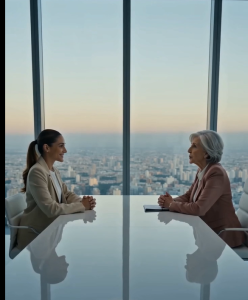
The office looked like the kind of place where every detail had been chosen to communicate control. Polished floors reflected the pale afternoon light, sleek white furniture sat in precise lines, and floor-to-ceiling windows framed a hazy skyline of glass towers and distant traffic. Even the silence felt expensive. At a narrow table near the windows, a young woman sat across from an older interviewer, her hands clasped neatly in front of her and her posture carefully composed. She had dark hair pulled into a neat ponytail, a beige blazer over a simple white T-shirt, and the bright, practiced smile of someone determined to make a strong first impression.
She had prepared for this meeting for days. She expected questions about experience, qualifications, judgment, and responsibility. She expected to explain why she wanted the position and why she believed she could succeed. What she did not expect was the strange familiarity in the older woman’s gaze.
The senior interviewer appeared calm and polished. Her short silver hair was perfectly styled, her pinkish-brown blazer sat neatly over a white blouse, and small pearl earrings caught the light whenever she moved her head. She studied the candidate for a moment longer than seemed necessary, then allowed a restrained smile to appear.
“So you’re also coming to look for a job?” she asked.
The question sounded ordinary on the surface, yet something in the delivery made the candidate hesitate. The young woman kept smiling, unsure whether the comment was meant as casual conversation or something more personal. The interviewer’s expression remained controlled, almost pleasant, but her eyes never left the candidate’s face.
A brief silence followed.
Then the older woman continued.
“Yes, how brave. I’d think you’d already be enjoying retirement.”
For a second, the words seemed to hang in the quiet office.
The candidate’s smile stayed in place, but only barely. She had entered the room believing she was being evaluated in a professional setting. Now the conversation carried an edge she could not explain. The remark about retirement did not fit the young woman sitting across the table, and that made it feel less like a simple mistake and more like a deliberate reference to something outside the interview.
Before she could respond, footsteps approached across the polished floor.
A woman in a light blue flight-crew shirt entered from the side of the office. Epaulets rested on her shoulders, a name tag was pinned neatly above her pocket, and a black skirt completed the formal uniform. Her arrival briefly restored a sense of procedure to the room. She moved with the calm efficiency of someone accustomed to schedules, rules, and formal introductions.
“We’re ready to start,” she said.
She looked toward the senior interviewer and gestured toward the candidate.
“Perfect, the candidate will be interviewed by you.”
The facilitator stepped aside, leaving the two women facing one another again. The city beyond the windows remained bright, but inside the office, the atmosphere had changed. The candidate’s smile slowly faded. Her hands were still clasped on the table, yet her fingers tightened together as if she were trying to steady herself without showing it.
A faint musical sting seemed to mark the shift.
The senior interviewer watched her closely.
Until that moment, the older woman had appeared almost casually amused. Now she moved with purpose. Her chair slid back across the floor with a quiet scrape. She stood, straightened her blazer, and leaned forward over the sleek table.
The gesture was not loud or aggressive. That made it more unsettling.
The pearl earrings, the silver hair, the composed face, and the steady eyes suddenly felt less like details of a stranger and more like pieces of a memory she had not expected to confront in this room.
The older woman spoke again, her voice calm.
“Let’s start with a simple question: Do you always judge people before getting to know them?”
The candidate froze.
Whatever professional answer she had prepared vanished from her expression. Her eyes widened, and her lips parted slightly as if she had forgotten how to respond. The confidence she had carried into the interview disappeared in an instant.
The question was simple, but it was not really about the job.
It was about judgment.
It was about assumptions.
And judging by the candidate’s reaction, it was about something that had happened before either woman entered this office.
The older woman did not raise her voice. She did not accuse the candidate of a specific act. She did not need to. Her quiet authority made the question feel more powerful than an angry confrontation would have been.
The young woman’s fingers remained locked together. Only now, the gesture no longer looked professional. It looked defensive.
She glanced briefly toward the facilitator, perhaps hoping for an explanation, but the other woman remained respectfully to the side. This was no longer a routine introduction. The senior interviewer had clearly chosen the first question for a reason.
The candidate’s face changed from surprise to recognition, then to panic.
Something hidden had surfaced.
Perhaps she remembered a previous encounter in which she had dismissed someone based on age, appearance, status, or circumstance. Perhaps she had made a careless remark without expecting to see that person again. The details were not spoken aloud, and no one in the room explained the past. But the emotional truth of the moment was unmistakable: the candidate understood why the question had been asked.
That realization turned the interview table into something larger than a place for résumés and formal answers.
It became a mirror.
Many people believe first impressions are harmless. In reality, a quick assumption can reveal more about the person making it than the person receiving it. Age, clothing, job title, social status, or appearance can tempt people into making instant conclusions. Yet those conclusions may collapse the moment circumstances change.
The young candidate had walked into the office expecting to be judged on her qualifications. Instead, she was confronted with the possibility that she had once judged someone else without knowing the full story.
That reversal gave the older woman’s question its weight.
She did not need revenge. She did not need humiliation. She only needed the candidate to understand what it felt like to sit beneath someone else’s assumptions.
The skyline stretched silently behind them as the candidate searched for words.
No answer came before the moment ended.
The final image was her shocked face, her earlier confidence replaced by the unmistakable fear of someone realizing that the past had arrived before she was ready to face it.
The lesson was not that age automatically brings wisdom or that younger people are naturally careless. It was simpler and more universal than that. Respect should not depend on what someone appears to be worth, how old they look, what uniform they wear, or whether they seem important at first glance.
A person who seems ordinary may hold authority. Someone dismissed as irrelevant may become the person asking the questions. And one careless judgment can return at the moment you least expect it.
In that bright office above the city, the interview had barely begun.
But the most important question had already been asked.





