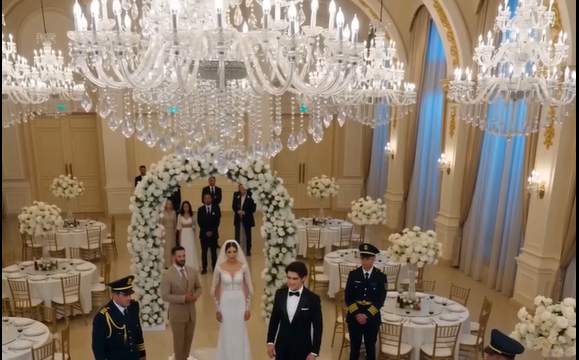
The ballroom looked like a place built for people who never needed to ask the price. Crystal chandeliers spread warm light across polished marble floors, gilded trim framed towering walls, and formally dressed guests moved between tables covered with fine glassware and elegant flowers. Men in tuxedos and women in evening gowns spoke quietly beneath the music, surrounded by diamonds, sequins, and the soft reflections of a high-society celebration. Everything suggested wealth, confidence, and perfect appearances.
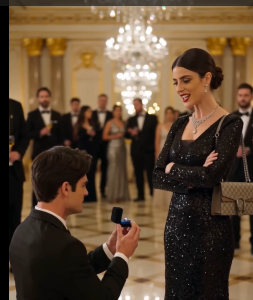
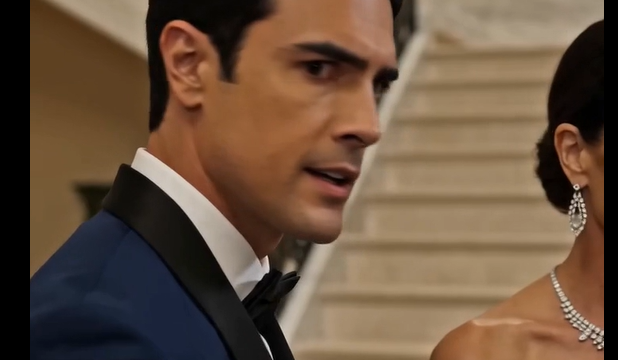
A handsome dark-haired man in a sharp black suit stepped toward a woman wearing a glittering black sequined gown. His white shirt and black tie were immaculate, but his expression was vulnerable. Tears already shone faintly in his eyes. He looked nervous, hopeful, and deeply sincere.
The woman seemed completely at home in the luxurious setting. Her dark hair was arranged in a sleek updo. A diamond necklace and matching earrings sparkled beneath the chandeliers, bold red lipstick sharpened her expression, and a luxury shoulder bag rested at her side. She watched him with both arms crossed as nearby guests slowly realized what was happening.
Then the man lowered himself onto one knee.
He opened a ring box and held it toward her.
The ring caught the ballroom light, flashing between his slightly trembling hands. For him, the moment was clearly more than a public gesture. He was offering a future and waiting for an answer from someone he trusted enough to love openly in front of everyone.
Instead, she stared down with visible disgust.
For a second, he seemed to hope she was merely surprised. His eyes searched her face for warmth or emotion. What he found was contempt.
“Do you think I’m going to marry you?” she said coldly.
“I’m too expensive for someone like you. I need men with real money.”
Her words carried far enough for surrounding guests to hear. Several exchanged uncomfortable glances. One woman lowered her glass. A man in a tuxedo looked away, embarrassed by the cruelty of a private rejection being delivered as a public judgment.
The man stayed on one knee.
He did not close the ring box. He did not argue, defend his income, or remind her of anything they may have shared. He simply absorbed the humiliation in silence.
The hope disappeared from his face first. Then came heartbreak.
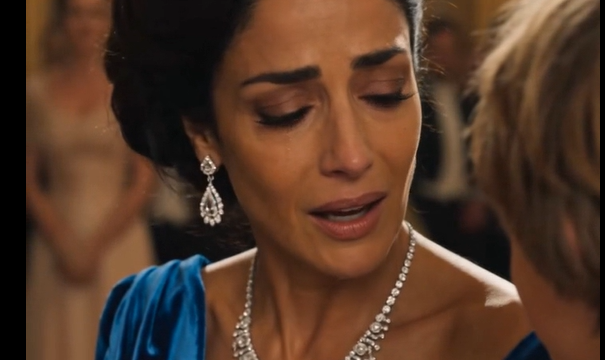
Tears gathered more clearly in his eyes under the warm chandelier light, but he remained composed. His silence made the moment heavier. He had approached her with vulnerability, only to hear that she measured his worth by money.
The woman kept her arms crossed. Her posture suggested complete confidence in her decision. To her, love without the level of wealth she wanted was not enough. Worse, she appeared willing to make that belief clear in front of an audience.
Around them, the glamorous ballroom no longer felt romantic. The chandeliers still glittered and the marble still reflected golden light, but the elegance only made the humiliation more uncomfortable. A proposal that might have become a treasured memory had turned into a painful spectacle about status.
The guests remained softly blurred behind the kneeling man. Some looked sympathetic. Others seemed stunned. No one stepped forward. The quiet tension grew as emotional music began to rise beneath the subdued party ambience.
A staff member in a formal black suit moved through the room with calm professional purpose. White gloves covered his hands, and his posture remained precise. He seemed focused only on delivering a message, not on the painful scene unfolding before him.
With perfect composure, he spoke loudly enough to be heard.
“Ms. Adrián, your helicopter is already ready.”
The announcement cut cleanly through the tension.
The man was still kneeling. The ring box was still open. The woman was still standing over him. Yet something in the room had changed immediately.
The name seemed to introduce a mystery no one had expected, while the word “helicopter” carried a message of its own. Someone called Ms. Adrián possessed enough wealth, influence, or importance to have private air transportation waiting.
The arrogant woman’s expression collapsed.
Her arms loosened. Her eyes widened dramatically. Her mouth opened in disbelief as though the announcement had forced her to reconsider everything she believed she understood about the people in front of her.
Only seconds earlier, she had declared herself too expensive for the man and insisted that she needed someone with real money. Now one sentence had shaken her certainty.
Perhaps she had misjudged the man kneeling before her. Perhaps the mysterious Ms. Adrián was connected to him. Perhaps someone else nearby held a position or fortune she had failed to recognize. The announcement did not explain enough to resolve the mystery, and that uncertainty made the reversal even sharper.
He did not reveal anyone’s net worth, announce a hidden company, describe a family fortune, or explain who owned the helicopter. He simply delivered the message he had been asked to deliver.
The guests began looking between the staff member, the stunned woman, and the kneeling man. Their expressions shifted from discomfort to curiosity. The woman who had seemed completely certain moments earlier now looked shaken by the possibility that appearances had deceived her.
His tears were still real. Her rejection had not become less hurtful simply because her confidence suddenly disappeared. Public humiliation does not vanish when the person causing it suspects she made a costly mistake.
When the woman believed the man lacked the wealth she desired, she did not reject him gently or privately. She diminished him in front of a room full of people. She reduced his value to what she assumed he could provide financially.
“Ms. Adrián, your helicopter is already ready.”
No one confirmed who Ms. Adrián really was. No one explained whose helicopter waited outside. No one answered the question spreading silently through the ballroom: Had the woman just humiliated someone far wealthier or more powerful than she realized?
The smugness was gone. The superiority was gone. Only shock remained.
Her eyes stayed wide as the music reached a sharp dramatic climax. Around her, the guests watched in silence. The man remained on one knee, holding the open ring box, his heartbreak unchanged even as the room’s balance of power shifted.
There was no apology. No identity was confirmed. No hidden fortune was formally revealed, and no second proposal followed. The story stopped at the instant certainty became doubt.
The unresolved twist mattered because it left the woman’s judgment exposed. She had treated another person as less valuable because she believed he lacked money. One unexpected sentence was enough to make her question whether she had understood anything at all.
But the emotional lesson was already visible. Wealth can be hidden. Status can change. Appearances can mislead. Character, however, often reveals itself in the way someone treats another person when they believe there is nothing to gain.
In a ballroom filled with chandeliers, diamonds, designer clothing, and polished marble, the most important thing on display was not the ring or the helicopter waiting beyond the building. It was the contrast between a man willing to offer his heart with humility and a woman who judged his worth before knowing the full truth.