The city plaza looked ordinary beneath a pale, overcast sky. Modern buildings rose beyond the bare trees, their glass and concrete surfaces reflecting the muted daylight. A few people moved through the open space, but no one seemed in a hurry to notice anyone else. Concrete benches lined the walkway, cold and gray against the quiet urban setting. In the middle of that familiar scene, a silver-haired businessman walked with the steady confidence of someone accustomed to schedules, meetings, and responsibilities.
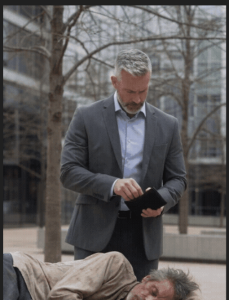
He wore a gray suit jacket over a light blue button-down shirt, dark gray dress pants, and a black leather belt. His neatly trimmed gray beard matched his hair, giving him a distinguished, professional appearance. His expression was composed, and his stride was purposeful. Nothing about him suggested that the next few minutes would matter more than whatever appointment might have been waiting for him.
Then something unexpected happened.
From just outside his line of sight, a hand reached toward his left shoulder. Only the hand and part of a tan sleeve were visible. The touch was gentle, almost careful, but it was enough to stop him immediately.
The businessman turned around.
Surprise crossed his face as he looked behind him, expecting to find the person who had touched him. Yet the mysterious figure was nowhere to be seen. Instead, his attention was drawn farther across the plaza, toward one of the concrete benches.
An elderly man was sleeping there.
The older stranger looked frail and exhausted. His gray hair was messy, his light-colored clothes were worn, and faded blue jeans covered his legs. Beneath his head was a stuffed sack that served as a makeshift pillow. He had no warm coat, no proper blanket, and no comfortable place to rest. The hard concrete bench beneath him offered little protection from the chilly air.
The businessman stood quietly still.
For a moment, the city seemed to fade around him. His surprise gave way to concern. Whatever had caused that unseen hand to touch his shoulder, it had redirected his attention toward a person most pedestrians might have passed without a second glance.
A moment later, the businessman was standing beside the bench.
He looked down at the sleeping man with quiet compassion. The elderly stranger did not stir. His breathing remained slow and peaceful, and his head stayed against the improvised pillow. The businessman reached into his pocket and removed a dark leather wallet.
He took the money out and paused, watching the man to make sure he would not wake him. Then, moving slowly and respectfully, he placed the folded cash into the sleeping man’s hands.
The gesture was simple, but the way he did it mattered.
He did not shake the man awake. He did not demand gratitude. He did not wait for anyone nearby to notice. There was no camera held in front of him, no speech, and no expectation of recognition. He simply left the money where the stranger would find it when he woke.
The air was cool, and the elderly stranger had almost nothing covering him. The businessman glanced down at his own gray suit jacket. It was part of the polished appearance he had carried through the plaza only moments earlier, a symbol of his professional life and the world he was walking back toward.
He slipped one arm free, then the other, and held the jacket in his hands. Leaning over the bench, he gently spread it across the sleeping man’s body like a blanket.
He adjusted the jacket so it covered the man more completely, making sure not to disturb his sleep. The gray fabric rested across the stranger’s chest and legs, offering a little warmth against the cold concrete and overcast day.
The businessman straightened and stood beside the bench for another moment.
It was not the smile of someone proud of being generous. It looked quieter than that. It was the expression of a man who had been reminded that compassion often begins when someone chooses to notice what is directly in front of them.
He did not know the older man’s name, his history, or how he had ended up sleeping outdoors. He could not know whether the folded bill would buy food, transportation, or something else urgently needed. His jacket could not erase every hardship waiting beyond that afternoon.
And sometimes, doing something with dignity matters more than making a grand gesture.
The businessman looked down one final time. The elderly man remained asleep beneath the gray jacket, the folded money resting safely in his hands. For the first time since entering the plaza, the businessman no longer seemed focused on where he had been going.
Then he turned toward the right side of the walkway and calmly walked away.
His light blue shirt was now exposed to the cool air, and the polished gray jacket that had completed his professional appearance stayed behind on the bench. Step by step, he moved out of view until the sleeping man was left alone in the frame.
The jacket had become more than clothing. The folded bill had become more than money. Together, they represented a moment in which one stranger recognized another person’s vulnerability and responded without judgment.
Who had touched the businessman’s shoulder?
Only a hand and part of a tan sleeve had been seen. The figure had vanished before the businessman could identify anyone. Perhaps it was another passerby who had noticed the sleeping man but could not help. Perhaps it was someone who understood that the businessman was in a position to make a difference. Or perhaps the mystery was never meant to be solved.
What mattered was where the touch led him.
It made him stop.
It made him turn.
Most importantly, it made him see.
In crowded cities, people often become part of the background. A person sleeping on a bench can become another shape beside the sidewalk. Someone struggling can disappear into the movement of commuters, traffic, phones, and deadlines.
Compassion does not always arrive with dramatic words. Sometimes it begins with a moment of attention. It can mean noticing someone who has been overlooked, offering help without taking away their dignity, and giving without needing applause in return.
The businessman never woke the older man to tell him what he had done. He never waited to receive thanks. He simply left warmth and assistance behind, then continued on his way.
The final image was peaceful.
The elderly man rested beneath the businessman’s gray jacket, his head still supported by the makeshift pillow. The folded money remained in his hands. Around him, the concrete plaza, bare trees, and modern buildings looked exactly as they had before.
But something had changed.
A stranger had been seen.
A need had been answered.
And somewhere beyond the frame, a businessman walked away with less than he arrived with, yet perhaps with a deeper understanding of what it means to be human.
The mystery of the unseen hand remained unresolved, giving the act an almost timeless quality. Whoever redirected his attention did not stay for credit. The businessman did not stay for credit either.
Only the kindness remained.
In the end, that was enough.





