The narrow cobblestone street looked almost timeless at dusk. Old stone buildings pressed close on both sides, their windows darkening as evening settled over the European-style alley. Warm wall lanterns glowed above weathered doorways, spreading soft pools of amber light across the wet-looking stones. The street was quiet enough that every footstep carried, yet there was something unsettled in the stillness, as though the fading day were holding its breath.
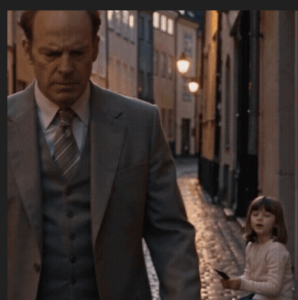
A middle-aged man walked slowly through the alley, dressed far more formally than the setting required. His grey three-piece suit was neatly tailored, his striped tie carefully knotted, but his posture betrayed exhaustion. His shoulders sagged slightly, and his thinning brown hair moved in the cool evening breeze. He looked like someone who had spent years learning how to continue moving even after the most important part of his life had stopped.
He rarely noticed much around him anymore.
Grief had changed the way he moved through the world. It had made familiar places seem distant and ordinary sounds feel muffled. Years had passed since his wife died, but time had not erased her from his thoughts. He still carried memories of her smile, her voice, and the small habits that once filled their home with life. He had learned to function without her, but he had never truly learned to stop missing her.
As he walked, one hand brushed against his jacket pocket.
A Polaroid photograph slipped free.
It fluttered once through the lantern light before landing faceup on the cobblestones behind him.
The man never noticed.
A few yards away, a little girl sat quietly on a low stone ledge beside one of the buildings. She had shoulder-length brown hair with straight bangs and wore a light pink long-sleeve sweater with a blue plaid skirt. Her feet barely reached the ground. She seemed perfectly content watching the street, calm and observant in the way children sometimes are when adults assume they are paying attention to nothing.
She saw the photograph fall.
The girl slid from the ledge, walked over, and picked it up carefully.
For a moment, she simply studied the image.
Inside the white Polaroid border was a beautiful woman with long brown hair, smiling directly at the camera. Her expression was warm and familiar, the kind of smile that suggested the person behind the camera mattered deeply to her.
The girl looked from the photograph to the man walking away.
Then she called after him.
“Sir, why do you have a photo of my mom?”
The man stopped.
His shoes went silent against the stone.
For one second, he remained completely still, as though his mind had heard the words but refused to understand them. Then he slowly turned around. The tiredness disappeared from his face, replaced by sharp confusion.
The little girl stood beneath the glow of a wall lantern, holding the Polaroid in both hands.
He stared at it.
Then at her.
He hurried back and crouched until he was at the child’s eye level. His movements were suddenly urgent, almost clumsy compared with the slow, distracted way he had been walking moments earlier.
“What did you say?”
The girl lifted the photograph slightly.
“My mom.”
The man reached for the Polaroid.
His fingers trembled as he took it from her.
The world around him seemed to narrow to the image in his hand.
There was no mistake.
He knew that face better than his own.
The woman in the photograph was his wife.
His late wife.
The woman he had loved, buried, mourned, and spent years trying to survive without.
His breathing changed. He looked at the photograph again as though some hidden detail might suddenly explain everything. The same long brown hair. The same smile. The same eyes he had seen across breakfast tables, crowded rooms, and quiet evenings at home.
It was her.
He looked back at the girl.
She did not appear frightened or confused. She was simply waiting, certain of what she had said.
A mysterious tension seemed to settle over the alley. The lanterns still glowed. The cobblestones still reflected the fading light. Somewhere farther down the street, a door closed softly. Yet for the man, nothing felt normal anymore.
His grief collided with disbelief.
Then disbelief became anger.
Not anger at the child exactly, but the desperate anger of someone being forced to confront an impossible claim. His brow tightened, his jaw set, and his voice emerged heavier than he intended.
“That is my wife. She died years ago.”
The words carried the weight of everything he had endured.
He was not merely correcting her.
He was defending the reality that had shaped his life.
He remembered losing his wife. He remembered the emptiness afterward. He remembered waking in rooms that suddenly felt too large and reaching for someone who was no longer there. He remembered condolences, painful silence, and the long months when even simple routines felt unbearable.
To him, her death was not a rumor.
It was the central fact of his grief.
The little girl, however, did not hesitate.
Her wide eyes remained fixed on him. There was no teasing in her expression, no uncertainty, and no sense that she understood how deeply her words were affecting the stranger crouched before her.
She spoke with the calm certainty of a child stating something obvious.
“No, my mom is alive.”
The man froze again.
This time, the shock was deeper.
His grip tightened around the edge of the Polaroid. His face lost some of its anger, replaced by something more fragile and desperate. He searched the girl’s expression for any sign that she might be mistaken, joking, or repeating something she did not understand.
He found none.
She looked completely certain.
Questions rushed through his mind faster than he could organize them. How could this child know the woman in the photograph? Why would she call her “mom”? Was there another woman who looked almost identical? Had someone lied to the girl? Had someone lied to him? Could the image have some explanation he had never considered?
Each possibility felt impossible.
Yet the girl was standing directly in front of him.
The photograph remained between them.
His wife’s smile seemed almost unbearable now. Moments earlier, the Polaroid had been a private reminder of a life he had lost. Now it had become evidence of a mystery that threatened everything he believed about the past.
The man looked down at the picture once more.
Then he looked at the child.
Her face was calm beneath the warm lantern light, but his was filled with disbelief, confusion, fear, and a desperate hope he did not dare recognize.
If she was wrong, the moment would become another cruel wound.
But if she was telling the truth, then his wife’s story had not ended where he believed it had.
Somewhere beyond that narrow street, a woman he had mourned for years might still be alive.
And with one innocent sentence, a little girl had turned his grief into a question that could no longer be ignored. Nothing on that quiet street had changed, yet for him, the entire meaning of his past had suddenly been thrown into doubt.