There are mornings when the world feels quiet in a way that hurts. It is not a peaceful quiet, but the kind of silence that settles over a place where nobody is coming. That was the silence around a weary mother dog in a cold, windswept meadow, and her story deserves to be told with care.
The field was nothing more than flattened, dry yellow grass scattered with stubborn patches of green weeds. At the far edge stood a dark line of dense trees and a few distant sheds, fading beneath a heavy grey sky. There was no shelter. There was no food and no water. There was no person in sight, only wind, cold, and a long stretch of emptiness.
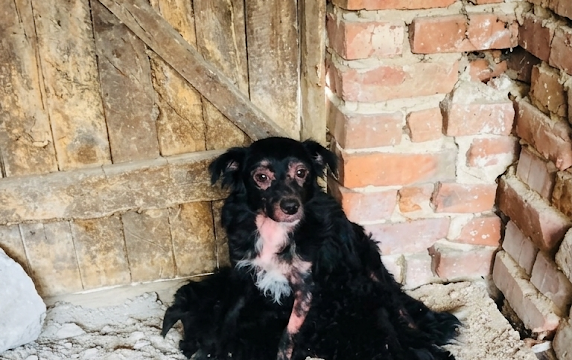
In the middle of it all lay a thin white-and-black spotted dog with a dark head. She had collapsed onto her side in the grass, her long, thin legs stretched out limply, her paws drooping, her slender tail lying still. Her head rested low and heavy against the ground. It was the posture of a body that had given everything it had and had nothing left to give.
Her belly was heavily swollen, the thin pink skin freckled with dark spots, stretched and tender. She was a mother, and she was carrying the weight of her babies on a frame that had clearly gone without enough food for far too long. Every rib showed. Every breath looked like work.
There is a particular kind of courage in a mother who is running on empty. She did not choose this field. She did not choose the cold, the hunger, or the long hours with nobody beside her. Yet there she was, still holding on, still carrying the little lives that depended on her. That kind of quiet strength rarely makes noise, but it is impossible to miss once you see it.
She shivered, and not gently. Her whole body quaked from her trembling shoulders to her shaking paws, the kind of shaking that comes from pain and cold at the same time. Her breathing was ragged and wet, her swollen belly and thin ribcage heaving with each labored breath. If you have ever watched someone you love struggle simply to breathe, you know how hard it is to look and how impossible it is to look away.
She made a soft, continuous whimper, like a small light growing dim. Every so often a thin, broken cry escaped her and faded into weak, trembling sobs. There was no one to answer it. There was only the rustle of dry grass beneath her body, the low sound of the wind, and the heavy silence of an empty field.
It is hard to describe what a cry like that does to a person. It is not loud. It is not dramatic. It is simply honest, the sound of a living being who has reached the end of what she can bear alone. In the stillness of that wide, grey meadow, it carried farther than she could have known.
Then, with great effort, she lifted her heavy head. Her dark eyes, glistening and glazed with tears, turned toward the lens and held there. She blinked slowly, as though even that took strength. A single tear rolled down her muzzle. It was a look that seemed to ask for someone, anyone, to stop, to see her, and to help her and the little ones she carried.
Her head sank back to the grass, trembling. A moment later she lifted it again, her legs shifting weakly in the dry grass, as if she were searching for a little more strength somewhere deep inside. Even at the bottom of her exhaustion, she kept reaching for whatever small hope was left.
Whoever stood watching stayed low, right at her level, quietly, as if holding their breath. There was no hurry, only a slow and gentle movement closer, because some moments call for stillness and respect. You could almost feel the cold rising from the ground, the wind pressing through the thin grass, and the sheer size of the emptiness around her.
Many of us who have lived long enough know what it means to go through the hardest hours alone. We know what it is to be tired in a way sleep cannot fix, and to wish that one kind person would simply appear. Maybe that is why a scene like this reaches so deep. A mother, spent and shaking, was still putting her babies first.
It would be easy to look away from a sight like this, but looking is where kindness begins. Every rescue story starts with someone noticing a living being in need and refusing to pass by. Dogs like this mother do not ask for much. They need a warm blanket, a bowl of food, clean water, and a gentle hand that says, “You are not alone anymore.”
We often talk about heroes as people who do something grand. In stories like this one, heroism looks smaller and closer to home. It looks like a neighbor who notices, a driver who slows down, or a stranger who turns around and goes back.
Stories like hers unfold in quiet corners all over the world, in fields and along roadsides and behind buildings, far from anyone who could help. Each one is a reminder of how much a small act of compassion can mean. It might be a phone call to a local rescue, a share that reaches the right person, or a donation that pays for a vet visit. None of it is too small.
Tonight, think of her lying in the cold grass, trembling, still lifting her head toward the lens in the hope that someone would finally see her. May we all be the kind of people who stop. May we all be the ones who answer the cry. And may every mother like her, in every cold and empty field, one day feel the warmth of a hand that came to help.