Three tiny puppies lay pressed together on a thin bed of dry straw, inside a battered green plastic tub, in a cold and quiet shed.
There was no mother beside them. There was no warm blanket and no bowl of milk. There was only the scuffed plastic beneath them, the dusty straw scattered across a bare floor, and a dark, empty doorway that no one seemed to walk through.
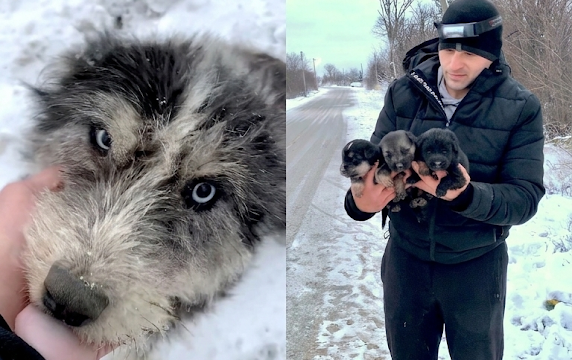
They were dark brown and black, with thin, dull fur and ears that looked far too big for their small heads. Even at that tender age, you could see how fragile they were. Their legs were thin and tucked in close. Their tails curled against their bodies. Their little heads hung low, tilted to one side, the way a child’s head droops when there is no strength left to hold it up.
They huddled together in one small cluster, and the whole bundle was shaking. It was not a gentle shiver. It was a deep, steady trembling that moved through all three bodies at once, as though the cold had settled into their bones. Each breath was shallow and wet, and you could see their tiny ribs rise and fall with the effort of it.
If you have ever held a newborn animal in your hands, you know how much warmth they need in those first weeks of life. They depend on their mother for everything. Her body heat, her milk, her gentle presence close by. Without those things, even a single cold night can be a heavy burden. These puppies looked as though they had faced far more than one.
The shed around them was dim and silent. The light was soft and flat, the kind that makes everything look a little colder than it is. A stained whitewashed wall stood behind them. A few loose strands of golden straw lay scattered across the floor, as if someone had meant to make a comfortable bed and had not finished the job.
And then there was the sound.
It was a soft, continuous whimpering that never quite stopped. Every so often, one of the puppies let out a thin, broken cry that seemed to fade away before it could travel anywhere. You could hear the dry rustle of straw each time their little bodies shifted. You could hear the soft scrape of tiny claws against the hard plastic. And underneath it all, you could hear the heavy silence of a place where no one was listening.
Then, slowly and with great effort, the puppies began to lift their heads.
One by one, they turned toward the camera. Their eyes were dark and glistening, glazed over and wet with tears that rolled down their small muzzles. They blinked slowly, as if even that took energy they barely had. For a moment, they simply looked into the lens, and it was almost impossible to look away.
Then their heads sank lower again, trembling. A moment later, they lifted once more, their tiny paws shifting weakly in the straw.
It is a quiet kind of heartbreak, watching something so small struggle so much. There is no loud drama in this scene. No rushing water, no storm, no dramatic chase. There is just a tub, some straw, and three little lives that needed someone to notice them.
Many of us who have spent our lives around animals know this feeling well. We remember the family dog who curled up at the foot of the bed. We remember the stray that wandered onto the porch one winter evening and never left. We remember how a single act of kindness, a warm towel, a saucer of milk, a soft word, can change the course of a small life.
That is why a scene like this stays with us. It reminds us how little it can take to make a difference, and how much is lost when no one stops to help.
Puppies this young cannot care for themselves. They cannot find food. They cannot keep themselves warm. They cannot ask for help in any way except the way they were asking: with small, broken cries and eyes that look straight at whoever might be watching. Everything they needed had to come from someone else.
Consider how fragile the very beginning of a life can be. In the first weeks, a puppy needs steady warmth, regular nourishment, and gentle care. Without them, a body that small can lose strength quickly. Anyone who has ever fostered a litter knows that those early days are a race, and every hour matters.
That is what makes scenes like this one so difficult, and so important to share. They invite us to pause. They ask us to look closely at something many people would rather not see. They remind us that behind every quiet shed, every forgotten box, and every lonely corner, there may be a small life waiting for someone to care.
And here is the truth that so many of us carry in our hearts: kindness does not have to be grand. Sometimes it is simply the willingness to stop. To kneel down at eye level. To listen to a faint cry and follow it to its source. To say, “I see you.”
The people who do this work, the rescuers, the volunteers, the neighbors who cannot walk past a cry in the night, are often ordinary people with ordinary schedules and ordinary worries. But when they hear a small voice calling out, they set everything else aside. They show us what compassion looks like when it is put into action.
If you have ever been that person, thank you. If you have ever wished you could be, remember that it starts with small things. A phone call to a local shelter. A donation of blankets or food. A few minutes of your time to share a story so that more people will know these little ones exist.
Three tiny puppies, a green plastic tub, and a cold, quiet shed. It is a simple picture, yet it carries a message that reaches straight to the heart. Every life, no matter how small, deserves warmth, food, and a gentle hand.
As you think about these three little ones, take a moment to hold your own loved ones a little closer. Whether they walk on two legs or four, they are a gift. And the world is made softer, one small kindness at a time, by people who refuse to look away.