There is a particular kind of silence that settles over an empty field in late autumn. The wind moves through bare branches, the grass lies flat and tired, and the ground holds the cold like a memory it cannot let go. On this gray afternoon, that silence was broken by something small and fragile: the shaky breathing of a dog who had almost nothing left, and yet was still carrying new life inside her.
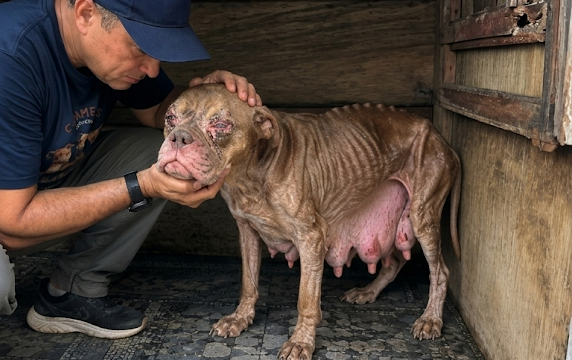
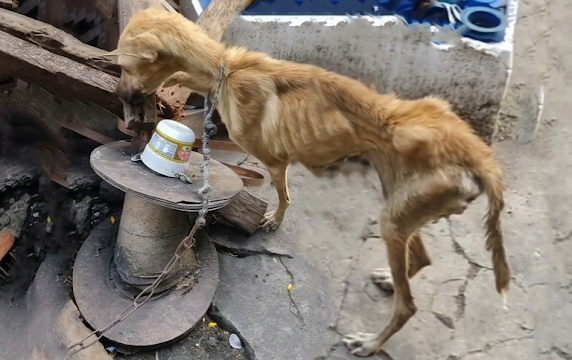
She stood on a muddy patch of grass, hunched and swaying, a brindle dog with white-tipped paws and a coat gone dull with dust. Her belly hung heavy and low, swollen with the puppies she was about to bring into the world. Her legs, thin and worn, could barely hold the weight. Every few seconds they buckled a little, then braced again, as though simply standing demanded every ounce of strength she had left.
One front paw hovered in the air. It was a small, trembling gesture, yet it said more than words ever could. It looked like someone reaching out, hoping a hand might reach back. Her hind legs shook in a half-crouch, and her tail hung low. Anyone who has loved a dog knows that posture. It belongs to a body pushed far past its limits, and to a heart that is still, somehow, asking for help.
She was shivering. It was not the gentle shiver of a chilly morning but a deep, uncontrollable shaking that traveled from her shoulders all the way down to her paws. Hunger, pain, and cold had settled into her thin frame together. Her ribcage rose and fell with every ragged, wet breath, and her swollen belly moved with it. It was hard to watch, and harder still to look away.
And then there was the sound. A soft, continuous whimper, barely louder than the wind, rose from her again and again. Every so often, a thin and broken cry escaped her and faded into weak, trembling sobs across the open field. There was no one nearby to hear it. No footsteps, no voices, no engine in the distance. Only the cold air carrying her small voice out over the grass and the mud, where it simply disappeared.
Listen closely and the field has its own voice. The soft squelch of mud beneath her trembling paws. The low, cold wind brushing through the bare branches. The heavy silence that falls between her cries. These small sounds, ordinary on their own, together paint a picture of a place where help has not yet arrived, and where every minute seems longer than the last.
Look at the place where she stood. A field of patchy green grass and churned brown mud stretched out in every direction. A low wooden fence leaned along one side, and a line of bare, leafless trees stood far in the distance beneath a heavy, overcast sky. There was no barn to shelter in, no blanket, no bowl of clean water, no warm corner. Nothing about the landscape offered comfort. It was simply wide, cold, and empty.
For a mother-to-be, shelter is not a luxury. It is everything. A dog about to give birth instinctively looks for a quiet, protected, dry place where her puppies can arrive safely and stay warm. Yet this brindle mother appeared to have found nothing of the kind. It looked as though she had been wandering these open fields for a long time, searching for a place that never appeared. Each step through the mud had cost her energy she could not afford to lose.
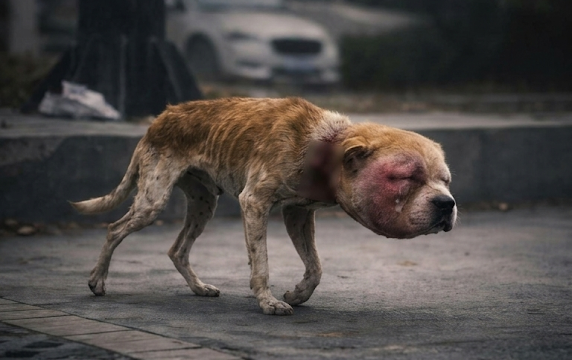
Her coat tells part of the story too. Dull, dusty, and clinging to her thin frame, it speaks of days without proper care. Beneath it, her ribs show with each breath, a reminder that the body working so hard to bring new life into the world has been given almost nothing to work with. Yet she carries on, step by careful step.
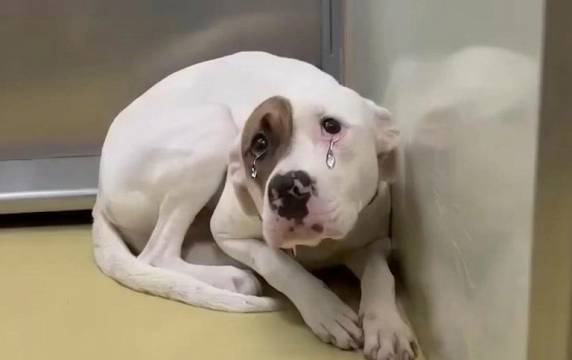
Slowly, with visible effort, she lifted her heavy head toward the camera. Her dark eyes were glazed and glistening, and a tear slid down her muzzle. She blinked slowly, the way someone does when they are too tired to say a word. For a moment, she simply looked straight into the lens, and it felt as though she were looking straight at each of us. It is a look that stays with you long after you have looked away.
Then her head sank lower again. The raised paw trembled in the air, and her legs gave a little in the wet mud. A moment later she gathered herself and lifted that paw toward us once more, fragile and unsteady. It was the smallest of movements, repeated with a stubbornness that is hard to put into words. Even in her weakest hour, she kept reaching.
Stories like this one touch something deep in us, and it is worth pausing to understand why. Many of us have known the quiet loyalty of a dog. We have come home to a wagging tail after a hard day, felt a warm head rest on our knee when words failed, and been forgiven for things we could not forgive ourselves. Dogs ask for so little. A bowl of food, a soft place to sleep, a gentle voice. When we see one without any of that, something in us aches.
For readers who have lived long enough to know what loneliness feels like, the scene can feel especially close to home. Most of us have had a season when the world seemed to go quiet, when we needed someone to notice and no one did. That may be why this mother’s raised paw feels so familiar. It is the universal gesture of anyone who has ever needed help and did not know how to ask for it.
It is also worth remembering how often animals in this situation go unseen. A pregnant stray does not announce herself. She does not knock on a door or wait at a bus stop. She moves along the edges of fields, behind buildings, beside roads, simply trying to get through one more cold day. Her story is usually told only in the faint tracks she leaves in the mud, and in the sounds the wind carries away.
Rescue workers and animal lovers often say that the first moments matter most. A mother in this condition, weak from hunger and cold, with her puppies close to arriving, faces real danger. Without warmth, food, clean water, and a safe place, both she and her babies are at risk. That is why a single moment of attention, one person who stops and looks and cares, can change the course of several lives at once.
Think about what she is carrying. Not just puppies, but the future of a small family. Each of those little ones will have a heartbeat, a curious nose, a tail that will one day wag at the sound of a familiar voice. They do not know yet about cold fields or empty skies. They only know the warmth of the body that holds them. Their mother, thin and trembling, is the entire world they have.
There is something quietly heroic in that. She had so little, and still she kept standing. Her body was shaking, her breath was uneven, and her strength was nearly gone, yet she stayed upright on that muddy ground, shielding the lives inside her. We often picture courage as something loud. Here it looked like a tired dog on a cold afternoon, simply refusing to lie down.
There is also a lesson here about patience and gentleness. A frightened, exhausted mother needs a calm approach: a soft voice, slow movements, a little food, and room to feel safe. Animals in distress read the world through tone and touch. The gentlest hands are often the ones who help the most.
If you are reading this and your heart has grown heavy, that is a good sign. It means compassion is still alive in you, and compassion is exactly what moments like this call for. You do not need to be a professional rescuer to make a difference. Sometimes it means calling a local shelter, sharing a story so the right person sees it, offering a blanket, or simply refusing to look away from an animal in need.
Local shelters and rescue groups are often stretched thin, and they rely on ordinary people more than most of us realize. A few dollars toward food, an hour of volunteering, a spare towel or blanket, or a willingness to foster a mother and her litter for a few weeks can be the difference between a hopeful beginning and a heartbreaking one. These are small acts, yet they ripple outward in ways we may never see.
It is also a reminder to look closely at the world around us. The next time you pass an empty lot, a quiet field, or a stretch of road where nothing seems to be happening, pause. Sometimes a life is waiting just beyond the edge of what we usually notice. A shape in the grass, a small cry on the wind, a pair of tired eyes looking back at you. Attention is a gift, and it costs us so little.
And there is hope, too, because hope is always part of these stories. Every day, ordinary people in towns across America open their doors, their trucks, and their hearts to animals just like her. Retired neighbors, farm families, teachers, nurses, and veterans have all stood in cold fields and chosen to help. Their names rarely make the news, but their kindness echoes for years.
As the scene fades, the brindle mother is still there, swaying slightly in the cold, one paw lifted, her gaze fixed on the lens. The wind still moves through the bare branches. The mud still clings to her white-tipped paws. We are left with her image and with a quiet question about what we would do if we stood in that field and saw her.
Perhaps that is the real gift of a story like this. It does not ask us to solve every problem in the world. It asks us to remember that kindness begins with seeing. To see the one who is suffering, to treat her as someone who matters, and to take the next small step, whatever that step may be.
This mother and her unborn puppies deserve warmth, food, and a safe place to rest. So do countless others like them. May we all be the kind of people who stop, who look, and who answer when a trembling paw reaches out for help. Every gentle hand begins with a single choice to care, and that choice can change everything.