For one long, fragile second, she forgot how to breathe.
It wasn’t because her son had been crying. She had seen him cry before—quiet tears as a boy, hidden frustration as a young man trying to carry more than he should. No, this was something else entirely. Something colder. Something sharper.
It was his hand.
The missing ring.
That small absence said more than any words ever could. Before she even unfolded the letter, before her trembling fingers could smooth the damp paper, she already knew that something irreversible had happened. Something final.
Still, she looked down and forced herself to read.
Her vision blurred, not just from the rain but from the sudden weight pressing against her chest. The handwriting was unmistakably his, but it wasn’t steady. Some lines were carved deeply into the page, the pen pressed so hard it nearly tore through. Others faded, as if he had paused, unsure, or perhaps afraid to continue. It looked like a conversation with himself—one filled with hesitation, doubt, and a quiet kind of desperation.
“She made me choose.”
The words landed heavily, like a stone dropped into still water, sending ripples through everything she thought she understood.
The younger woman at the gate had not been a passive observer. She had not simply stood there out of curiosity. No, she had been watching carefully, measuring every glance, every movement, every exchange. Her silence had not been neutral—it had been loaded, expectant, demanding.
And suddenly, the mother understood.
This had not been a single moment of tension. It had been building for a long time. Months, maybe even years. Small disagreements that slowly grew sharper. Complaints whispered at first, then spoken more openly. The groceries he brought. The medicine he paid for. The rent he quietly covered when she could no longer manage. Each act of care had become a point of conflict.
Love, in its simplest form, had been turned into something suspicious.
Every visit had become an argument waiting to happen. Every gesture of kindness had been questioned, criticized, diminished. What once came naturally to him—helping the woman who raised him—had been reframed as weakness. As something unnecessary. Even burdensome.
And then, inevitably, came the ultimatum.
Her or his mother.
A choice no child should ever be asked to make.
But he hadn’t chosen—not in the way anyone expected. Not in the way that would satisfy either side.
Instead, he had done something else entirely.
He sold the ring.
The truth settled in slowly, painfully. That was where the money had come from. Not from a lucky break. Not from careful savings. Not from any hidden source of income. It had come from the one thing that still belonged entirely to him—the symbol of his marriage, his commitment, his place in the life he had built.
He had given that up. Quietly. Completely.
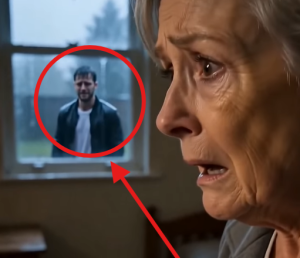
The mother lifted her gaze and looked through the rain-streaked window again, hoping, just for a second, that he might still be there. That maybe he hadn’t gone far. That maybe she could call out to him and undo whatever had just happened.
But the yard was empty now.
Only the gate trembled in the wind, rattling faintly as if it, too, had been shaken by the moment.
She turned back to the letter, her hands unsteady, and read the final lines.
“You fed me when you had no food. You covered me when you had no blanket. I won’t let you grow old hungry while I stand under a roof. Forgive me for making it look ugly.”
That was the moment everything broke.
Not the money. Not even the apology.
It was that last sentence.
Because it revealed the truth he had worked so hard to hide.
The roughness in his voice. The way he had shoved the sack into her arms. The way he refused to meet her eyes. It hadn’t been cruelty born from anger. It had been something far more deliberate.
He had made himself look cold.
He had chosen to appear distant, even unkind, because it was the only way to protect what still mattered to him.
In front of the woman watching from the doorway, he needed to seem detached. Unfeeling. As if this act meant nothing. As if there were no love behind it at all.
But in truth, it was love—compressed, hidden, and reshaped into something almost unrecognizable.
He had allowed himself to be misunderstood.
He had accepted being seen as heartless so that, deep inside, he could still remain a son who honored what he owed to the woman who raised him.
The mother pressed the letter tightly against her chest. At first, her tears came quietly, slipping down her face without sound. But soon, they grew heavier, carried by the full weight of understanding.
Because she saw it now, all of it, at once.
He had not stopped loving her.
He had simply run out of ways to show it safely.
So he hid it. Wrapped it in something harsh and imperfect. Something that could pass unnoticed by others but would still reach her, if she looked closely enough.
That was the form his love had taken.
And it was enough to break her heart.
As she lowered the letter, something else caught her attention. Inside the envelope, tucked carefully along the fold, was a small key.
Her fingers trembled as she pulled it free.
There was one final line written beneath it.
“If I don’t come back, the locker is yours. I put everything there before she could take it.”
The meaning of those words settled in slowly, replacing grief with something far more unsettling.
Fear.
Because this was no longer just about a man caught between two people he cared about.
This was about someone preparing for something uncertain. Something dangerous, in its own quiet way.
He had already given up the ring. He had already parted with the last thing that tied him to one life. And now, he was leaving behind everything else, just in case he couldn’t return.
That realization changed everything.
The sack of rice suddenly felt heavier in her arms. Not because of what it contained, but because of what it represented.
It was never just food.
It was never just help.
It was a farewell, carefully disguised. A final act of love hidden beneath layers of pride, sacrifice, and silent struggle.
He hadn’t wanted her to see it as goodbye.
He hadn’t wanted anyone to see the truth.
But now she understood.
And that understanding came with a cost she could feel in every part of her being.
Standing there, with the rain still falling and the gate still trembling in the distance, she realized that love does not always arrive gently. Sometimes it comes disguised as something else entirely—something rough, something difficult, something that almost looks like the opposite of what it truly is.
But when you see it clearly, when you understand what it took to give it, there is no mistaking its depth.
And in that moment, holding the letter and the key, she knew that her son had not walked away from her.
He had carried her with him, even as he disappeared into a storm she could no longer follow.