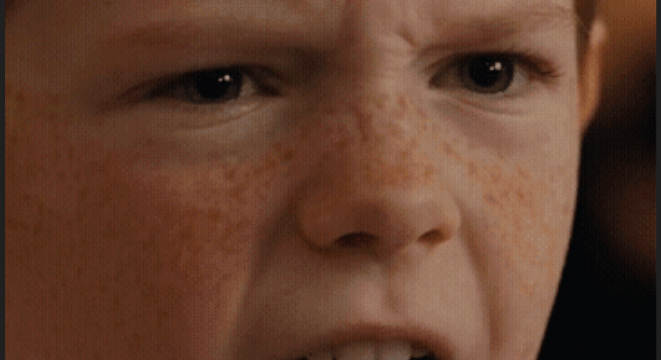
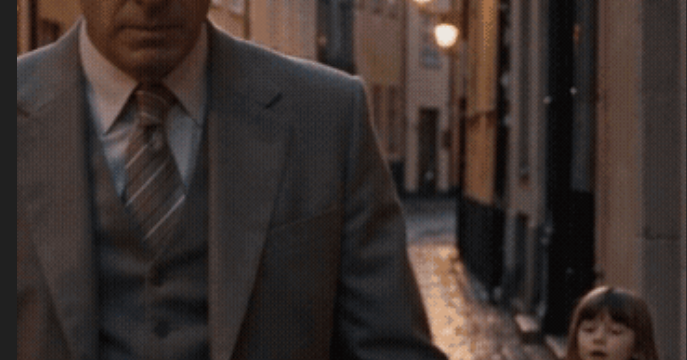
For one long, suspended second, the entire funeral room seemed to dissolve into silence.
The flowers were still there, arranged in careful white clusters around the casket. The mourners remained seated in neat rows, dressed in respectful black, whispering condolences that sounded hollow even to themselves. The polished wood of the coffin reflected the soft light overhead. Everything was exactly as it should be.
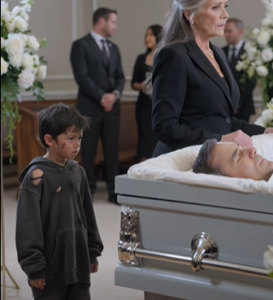
And yet, none of it mattered.
Because all she could see was the little boy.
And the words written on the back of the card he held.
Her hand trembled at her side, a subtle movement no one else noticed. Years of discipline had taught her how to maintain composure, how to keep emotions carefully sealed beneath a surface of grace and control. But this—this was something she had not prepared for.
Because she recognized the truth immediately.
Years ago, long before appearances hardened into expectations and family reputation became something to protect at all costs, her brother—the man now lying in that casket—had fallen deeply in love.
It had not been a suitable match.
The woman he chose came from nothing the family respected. She was young, struggling, and completely outside the carefully maintained world they lived in. To them, she was an inconvenience. A mistake.
And when she became pregnant, the situation was no longer something that could be ignored.
Families like theirs did not tolerate scandal. Not when inheritance, influence, and carefully built reputations were at stake. They handled problems quietly, efficiently, and without leaving a trace.
So they erased it.
Money was exchanged in hushed conversations behind closed doors. Documents disappeared as though they had never existed. The young woman was pushed out, sent away with nothing but the understanding that she was no longer welcome.
And the child?
The child was never acknowledged.
The responsibility of making all of this happen had fallen to her—the older sister. The composed, dependable one. The one who always did what was expected, no matter the cost.
She had carried out the orders.
Mostly.
There had been one thing she could not bring herself to do.
A gold watch.
It had belonged to their father, passed down to her brother with quiet pride. On the back, carefully engraved, was a date and a promise—simple, but meaningful.
She had been told to dispose of it. To remove any trace that could connect her brother to a life the family had chosen to erase.
But she couldn’t.
Instead, she hid it.
Somewhere deep inside, she had held onto a thought she never dared to speak aloud: if a child ever returned one day, that watch could prove what had been denied.
And now, standing in that room filled with flowers and carefully constructed grief, that impossible moment had arrived.
The child had come back.
Not as a grown man demanding answers. Not as someone powerful enough to challenge the family’s silence.
Just a boy.
Thin. Quiet. Clearly hungry. His clothes worn from use, his posture small but steady. He stood beside the casket, close enough to touch it, as if trying to understand something far too large for him.
The woman looked at him again, this time without the filter of denial.
And suddenly, she saw everything.
Her brother’s eyes stared back at her—soft, observant, carrying a depth that did not belong to a child. The shape of his face mirrored the family’s unmistakable features. Even the way he held himself, still and restrained, was painfully familiar. It was the same stillness her brother used to carry when he was holding back emotion.
Her voice almost failed her when she spoke.
“How long were you with him?”
The boy lowered his gaze, his fingers tightening slightly around the edge of the card.
“Three weeks,” he said quietly.
The answer struck harder than she expected.
Three weeks.
That meant her brother had found his son at the very end of his life. Not early enough to raise him. Not in time to repair the damage done by years of silence and absence.
Only long enough to recognize him.
Only long enough to leave something behind.
The woman swallowed, her throat tight.
“Where is your mother?” she asked gently.
The boy’s voice softened even more.
“She died last winter.”
The words settled heavily in the air.
There was no reaction from the room. No dramatic shift, no sudden movement. Just a deepening silence that seemed to press down on everyone present.
And then the boy added, almost as if repeating something important:
“He said I’m all that’s left.”
That was the moment everything changed.
The woman closed her eyes briefly, just long enough to steady herself.
Because this was no longer just a funeral for her brother.
It was something else entirely.
A reckoning.
All the years she had convinced herself that obedience was necessary. All the times she had chosen silence over truth, believing it was the only way to preserve stability. All the moments a child had existed somewhere outside the family’s carefully maintained world, while inside, everything remained polished and untouched.
Now that child was here.
Not asking for sympathy.
Not demanding anything.
Just standing there, carrying the truth they had tried to bury.
Slowly, deliberately, the woman reached into her handbag.
Her fingers found the small velvet pouch she had kept hidden for years. She had brought it with her to the funeral without fully understanding why. Perhaps some part of her had always known this moment might come.
She opened it carefully.
Inside was the gold watch.
Time had softened its shine, but the engraving on the back was still there, faint but legible.
She stepped closer to the boy.
The room seemed to hold its breath as she placed the watch into his hands.
He looked down at it, confusion flickering across his face as his fingers traced the worn metal.
Then he turned it over.
The family name was there.
And beneath it, in delicate, faded lettering:
For my son.
The boy’s eyes lifted slowly to meet hers.
In that quiet exchange, something passed between them—an understanding that did not need to be spoken aloud.
Around them, the room remained filled with flowers, with people, with the weight of unspoken history.
But for the woman, everything had shifted.
For the first time, she understood something with absolute clarity.
The child standing beside the casket had not come for charity.
He had not come out of desperation or to ask for help.
He had come for something far more important.
He had come to be seen.
To be acknowledged.
To stand in the one place where the truth could no longer be denied, before the last person who knew it was gone forever.
And in that moment, the elegant woman in black finally let go of the silence she had carried for so many years.
Because some truths, no matter how deeply they are buried, always find their way back to the surface.
And when they do, they demand to be recognized.