Every evening after my shift at the city hospital, I walked the same route home. It was not the shortest way, but it was familiar, and after everything I had lost, familiar things mattered. The hospital doors usually slid shut behind me long after sunset. By then, my feet ached, my back felt stiff, and my mind carried the weight of other people’s pain.
A year earlier, my husband had died suddenly, and the apartment we had once shared no longer felt like home. His coat still hung in the closet. His coffee mug stayed on the second shelf because I could never bring myself to move it. At night, the silence was so heavy that I often turned on the television just to hear another voice.
Work became my refuge. At the hospital, I had tasks, patients, alarms, charts, and people who needed me. At home, I had only memories.
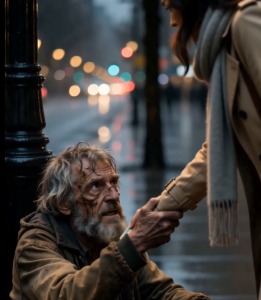
Every night, before reaching my building, I passed the same intersection. Beside an old streetlamp, beyond the bus stop, sat a homeless man. He was always there. In summer, he shaded his face with a torn baseball cap. In autumn, rain soaked through his coat. In winter, he wrapped himself in a faded blanket and pressed his hands together for warmth. In front of him lay the same piece of cardboard, the letters written in black marker.
For food and medicine.
The first time I noticed him, I gave him a few coins. Later, I left a few bills, a sandwich, or hot tea. He never begged loudly. He never followed anyone. He simply nodded, accepted what was offered, and said, “Thank you, ma’am,” in a soft, careful voice.
Months passed that way. I still did not know his name, and he never asked for mine. Yet in the tired rhythm of my evenings, seeing him became part of my routine. I told myself it was a small kindness, nothing more. Maybe I helped him survive another cold night. Maybe helping him made my emptiness feel slightly less useless.
One Thursday evening, rain poured down so hard that the sidewalks looked like black glass. Cars crept through puddles, and the streetlights stretched across the wet pavement in long yellow lines. I had just finished a brutal shift. Two emergencies had come in back to back, and by the time I stepped outside, I felt hollow.
Still, I stopped at the intersection. The man sat under the streetlamp, his blanket pulled over his shoulders, water dripping from the edge. I reached into my coat pocket, pulled out damp bills, and bent down to hand them to him.
He did not take them right away.
Instead, he lifted his eyes to mine. His expression was different. Not grateful. Not tired. Afraid.
Before I could ask what was wrong, he reached out and grabbed my wrist.
I froze.
He had never touched me before.
“Don’t sleep in your bed tonight,” he whispered.
I stared at him, certain I had misheard. “Excuse me?”
His fingers tightened, not enough to hurt, but enough to make me listen. “Do not stay at home tonight. Not in your bed. Tomorrow, I’ll explain everything.”
A cold feeling moved through me that had nothing to do with the rain. “What are you talking about?”
“Please,” he said. His voice shook. “Trust me just this once. Go somewhere else. Stay with a friend. Stay at a hotel. Sit in the hospital lounge if you have to. Just don’t go to sleep in that apartment.”
I pulled my arm free and stepped back. My heart beat faster, but confusion was stronger than fear. “You’re scaring me.”
“I know.” He lowered his head, as if ashamed. “But being scared tonight may keep you alive.”
The words sounded impossible, almost cruel. I backed away, clutching my bag. For the rest of the walk, his warning echoed in my head. Don’t sleep in your bed tonight. Tomorrow I’ll explain everything.
By the time I reached my building, I had almost convinced myself he was unwell. Maybe he had seen too many hard days. Maybe the storm had made him anxious. Maybe grief had made me too easy to frighten.
My apartment was dark when I opened the door. I turned on the hallway light and stood still, listening. Nothing seemed unusual. The living room was quiet. The kitchen smelled faintly of the cleaner I had used that morning. My bed was made exactly as I had left it.
I laughed nervously at myself. Then I remembered the look in his eyes.
I could not explain why, but I did not go to the bedroom. Instead, I changed into dry clothes, grabbed an old blanket, and settled on the couch in the living room. I left a lamp on. I told myself I was being ridiculous, that tomorrow I would feel embarrassed, that a tired nurse had let a stranger’s fear crawl under her skin.
Sometime after midnight, a sharp cracking sound tore me awake.
For a moment, I did not understand where I was. Then came a violent crash from the bedroom, followed by the groan of wood splitting and glass shattering.
I stumbled to my feet, trembling so badly I nearly fell. When I reached the doorway, I covered my mouth.
The ceiling above my bed had collapsed.
A huge section of soaked plaster, old beams, and broken pipes had crashed directly onto the mattress. Rainwater poured through a ragged hole above it. My pillow was buried beneath debris. The place where my head would have been was crushed under a wooden beam.
I stood there quietly in the doorway, unable to breathe.
If I had slept in that bed, I would not have survived.
Neighbors came running. Someone called emergency services. The building manager arrived pale and shaking, muttering about an upstairs leak, old repairs, and damage no one had properly inspected. I barely heard him. All I could hear was the homeless man’s voice.
Don’t sleep in your bed tonight.
The next morning, wrapped in a borrowed coat and numb from shock, I went straight back to the intersection. The rain had stopped, but the street was gray and cold. He was there, sitting beside the same streetlamp, as if nothing had changed.
When he saw me, his shoulders relaxed.
“You listened,” he said.
I knelt in front of him. “How did you know?”
He looked down at his hands. “Before I lost everything, I worked maintenance in that building. Years ago. I knew the old water line above your room was bad. Yesterday, I saw water running down the wall near your window. With that storm, I knew the ceiling might not hold.”
“You could have told the manager.”
“I tried once,” he said quietly. “People don’t always listen to men who sleep on sidewalks.”
I felt tears rise. All those months, I thought I was the one helping him. In the end, a man the world barely noticed had saved my life.
That day, I learned that kindness is never one-sided. Sometimes the person you lift up is quietly watching over you too. And sometimes, the smallest act of compassion comes back when you need it most.