Everyone laughed at the strange stakes on her roof, but when winter arrived, the whole village finally understood the wisdom they had mocked.
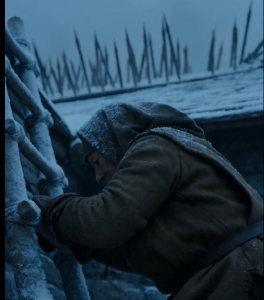
All summer and autumn, people watched Margaret Hale climb onto her old roof with bundles of wood and a hammer in her apron pocket. At first, they assumed she was repairing loose shingles before winter. Her cottage was one of the oldest on the lane, with a sagging porch, pale curtains, and a chimney that smoked only at dawn. But after several days, everyone saw she was not fixing the roof in any ordinary way.
Every morning, Margaret carried sharp wooden stakes up the ladder and fastened them across the shingles. One row became two. Two became four. By August, the roof looked bristled and strange.
People stared first. Then they whispered.
“Have you seen her house?” Mrs. Palmer asked outside the village store.
“I have,” another woman replied. “Ever since Samuel died, she hasn’t been right.”
That explanation satisfied them. Margaret’s husband had passed away the year before, and since then she had lived quietly. She bought bread, paid bills, watered her garden, and rarely joined conversations. To her neighbors, silence looked like sadness, and sadness, if it lasted long enough, began to look like madness.
So they decided Margaret had lost her senses.
The rumors grew as the stakes multiplied. Some said she was protecting herself from spirits. Others called it a strange renovation. A few joked that she was building a private fortress.
“A normal person would never put something like that up there,” Mr. Dawson said. “Everything is sharp. It looks like a trap.”
Margaret heard more than they realized. In a small village, whispers travel faster than letters. She heard them while buying nails. She saw people glance at her roof, then look away. Still, every morning, she climbed.
The work was harder than anyone knew. Her knees ached. Her fingers stiffened around the hammer. Sometimes she sat on the roof ridge until the dizziness passed. But she kept working.
She chose every stake from dry, seasoned wood. Green wood would swell and split. Soft wood would fail. Samuel had taught her that. He had been a carpenter, and he used to say, “Never build for the weather you want. Build for the weather that is coming.”
Margaret remembered.
She sharpened each piece carefully, sealed the base against moisture, and placed every stake where the roof could bear it. Inside the attic, she reinforced weak spots. Nothing about her work was careless.
But from the ground, people saw only an old widow surrounded by pointed wood.
One September afternoon, a neighbor named Daniel crossed the road. He had not yet learned the habit of watching without helping.
“Mrs. Hale,” he called, “do you need a hand?”
Margaret looked down. “I can manage.”
“I believe you,” Daniel said. “But that doesn’t mean you should have to.”
She studied him, then climbed down slowly.
“Why are you doing this?” he asked gently.
Margaret looked toward the dark pine ridge.
“This is my protection,” she said.
“Protection from whom?”
“Not whom,” she answered. “What.”
Daniel waited.
“From what is coming.”
She explained nothing more. But the next morning, he returned with gloves and coffee. Margaret handed him a stake and showed him the angle.
Daniel kept helping. As they worked, Margaret told him the truth. She spoke of winters decades earlier, when snow had buried fences, flattened barns, and trapped families indoors. Samuel had warned that smooth, aging roofs could send heavy sheets of snow and ice crashing down.
“People forget,” Margaret said. “The last few winters were gentle, so they think the next one will be kind.”
Daniel looked at the stakes. “So these are snow guards?”
Margaret nodded. “Old-fashioned ones. They hold the pack, break the slide, and keep it from falling all at once. My roof faces the road. Children walk there. So does the mailman. So does anyone going to the store.”
For the first time, the strange roof did not look frightening. It looked watchful.
By November, the roof was finished. The village had grown used to the sight, but not kinder. Margaret stored her tools, stacked firewood, and waited.
Winter came in early December with a pale sky and a silence that pressed down on the valley. The first snow was pretty, soft enough to make postcards out of fences and trees.
Then the second storm arrived.
Snow fell for thirty-six hours. Wind shoved drifts against doors. Branches cracked under white weight. By the third morning, every roof carried a frozen burden.
At noon, the temperature rose enough to make the danger invisible. Snow softened on top. Ice loosened underneath. Suddenly, a sheet slid from Mr. Dawson’s roof with a roar and crashed onto his front steps, splitting the railing where his wife had stood moments before.
People rushed outside.
Then the store awning released. Snow and ice thundered down, crushing a bench and scattering boards across the sidewalk. Someone shouted for the children to move back. The village finally understood that snow could become weight, and weight could become danger.
Across the road, Margaret’s roof held.
The snow did not fall in one deadly sheet. The wooden stakes caught it, divided it, slowed it, and broke it into smaller chunks that dropped harmlessly along the eaves. The lane in front of her house stayed safe enough to pass. The mailman, walking there when the thaw began, stopped and looked up.
By evening, neighbors gathered in the road, staring at the roof they had mocked for months.
Mrs. Palmer approached the porch first.
“Margaret,” she said softly, “you knew.”
Margaret opened the door.
“I remembered,” she replied.
Mr. Dawson removed his cap. “We thought…”
“I know what you thought,” Margaret said.
No one argued. The proof was above them.
Daniel stepped from the shed with a shovel. “She was protecting more than her own house,” he said. “She was thinking about the whole road.”
People looked at the path where children walked, the place where the mailman had stood, and the crushed bench near the store. Their judgment had been easy. Her work had been lonely.
The next morning, neighbors knocked on Margaret’s door. They brought lumber, nails, soup, coffee, and apologies. Margaret showed them how to choose dry wood, brace weak beams, and place each stake with purpose.
By the end of the week, several houses had wooden snow guards of their own. They were not pretty, but they worked.
And slowly, the story changed.
The old woman had not been mad. She had been patient. She had not been building a trap. She had been building protection. While others laughed through summer and judged through autumn, she prepared for a danger they refused to imagine.
That winter became one the village remembered for years. They remembered storms, broken railings, crushed bench, and the sound of ice falling from rooftops. Most of all, they remembered Margaret Hale, the quiet widow who climbed a ladder every morning while everyone called her strange.
After that, whenever someone was tempted to laugh at what they did not understand, another person would glance toward Margaret’s house and say, “Wait until winter.”
Because wisdom does not always explain itself. Sometimes it works in silence, endures the whispers, and lets the first storm reveal the truth.