At first, we thought our dog was just nervous in the new house. But when she kept barking at the same bedroom wall night after night, we finally listened—and uncovered a forgotten secret hidden for decades.
When my husband, our daughter, and I bought the house at the edge of town, I believed we had found the place where our family could finally breathe again. For years we had lived in cramped apartments, listening to neighbors through thin walls and dreaming of a yard where our child could play safely. This house was not new, but it had character. The floors were polished, the rooms were wide, and the garden faced a quiet line of trees. I remember standing in the bedroom on our first day there, smiling at my husband and thinking this was where our happier life would begin.
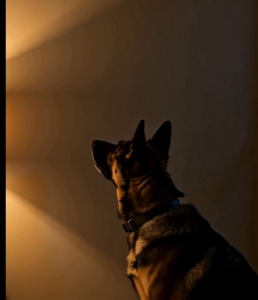
Our Doberman, Rada, seemed to approve at first. She had always been loyal, watchful, and smart in a way that sometimes felt almost human. The moment we opened the front door, she rushed inside, sniffing corners, tapping across the floors, and checking every room. Our daughter laughed as Rada raced from the hallway to the kitchen and back.
Rada had chosen one particular spot in our bedroom, near the far wall beside the wardrobe. She would sit there for several minutes, staring directly at the wallpaper. At first, we thought there might be an insect behind a loose corner or maybe a faint sound from the pipes. My husband pressed his ear against the wall and heard nothing. I ran my hand over the wallpaper and felt nothing unusual. There were no stains, cracks, smells, or damage. Just an ordinary wall.
Still, Rada kept watching it.
For the first week, we treated it like a strange habit. Some dogs chase shadows. Some bark at mirrors. Some become suspicious of vacuum cleaners. We told ourselves she was adjusting to the move. Old houses have unfamiliar sounds. They creak at night, shift with temperature, and carry echoes from empty rooms. We believed Rada would settle down once the house felt like home.
Instead, her behavior became stronger.
During the day she would walk into the bedroom, stop in the exact same place, and stare. Her ears stood high. Her body went stiff. Sometimes she tilted her head, listening to something we could not hear. Then she began to growl. It was low at first, a quiet warning deep in her throat. Later, she started barking sharply, stepping closer to the wall and scratching at the wallpaper with her front paws.
In every other part of the house, she behaved normally. She played with our daughter in the garden. She slept peacefully in the living room. She greeted us at the door with her usual happy energy. But the moment she entered our bedroom, everything changed. Her eyes locked on that wall, and nothing could distract her.
A few hours after we fell asleep, Rada would leap up and bark so loudly that my heart nearly jumped out of my chest. Each time, she faced the same wall. My husband would switch on the lamp and tell her to stop. I would call her name softly, trying to calm her. Our daughter would wake up frightened from the next room. We would check the wall, the floor, the windows, and outside. Nothing.
After several sleepless nights, patience turned into frustration. My husband scolded Rada more than once, which made me feel guilty because I could see she was not misbehaving for attention. She was trying to tell us something. I just did not know what.
Then one night, her barking changed.
It was not the usual sharp, angry sound. It was desperate. She scratched at the wall until a strip of wallpaper tore loose, then backed away and barked again, looking from me to my husband as if begging us to understand. I felt a cold pressure settle in my stomach. My husband saw my face and stopped complaining.
“Maybe there really is something in there,” he said quietly.
The next morning, we called a builder we knew, a practical man named Paul. He smiled at the idea of a dog discovering a secret in a wall, but agreed to take a look. He tapped the plaster in several places, listened carefully, then frowned. One section sounded different. Hollower.
Paul asked if the previous owners had mentioned renovations. They had not. He examined the edges near the floor and said part of the wall might have been closed up later. My husband and I exchanged uneasy looks. Rada stood beside us, silent for once, her eyes fixed on Paul’s tools.
We moved the wardrobe away, covered the floor with old sheets, and asked our daughter to wait in the kitchen. Paul started carefully, cutting into the plaster so he would not damage wires or pipes. With every piece he removed, Rada grew more tense. She did not bark now. She only watched.
Then Paul stopped.
Behind the wall was a narrow hidden cavity, not large enough for a person to stand in, but wide enough to store something. At first all we saw was darkness and dust. Then Paul shone his flashlight inside, and the beam caught a small metal box resting on a wooden ledge. Beside it were old newspapers, a child’s broken toy horse, and folded blankets wrapped in plastic.
No one spoke.
My husband reached for my hand. Paul gently pulled the box out and set it on the floor. It was rusted around the corners but still locked. The newspapers were dated more than thirty years earlier. The toy horse looked handmade, its paint faded but still detailed. The blankets, though dusty, had been wrapped with care.
We called the local authorities before opening anything. It seemed responsible, especially since the items had been hidden for decades. An officer arrived later, along with a woman from the historical society. When they opened the box, we found letters, photographs, and a small bundle of jewelry that looked old but not especially expensive.
The letters revealed the truth. Many years ago, a woman had lived in the house with her young son during a painful family dispute. Before leaving suddenly, she had hidden the box in the wall to protect memories and personal keepsakes she feared would be taken. For reasons no one fully understood, she never returned. The house changed hands, the wall was sealed, and her little collection remained forgotten.
A week later, an elderly man came to our home. He was the woman’s son, now in his seventies. When he saw the toy horse, he covered his mouth and began to cry. His mother had made it for him when he was a child. He had believed it was lost forever.
In that moment, all our fear turned into something softer. Rada had not been warning us about danger. She had been leading us to a forgotten piece of someone’s life. Maybe she heard tiny shifts behind the wall. Maybe she smelled the old blankets. Maybe dogs simply understand things we overlook.
Now the wall has been repaired, but we left a small framed photo of Rada on the bedroom shelf. Every time I see it, I remember those sleepless nights and the lesson our dog taught us: sometimes the ones who cannot speak are the ones trying hardest to be heard.
Word count: 1199 words.