At 50 and beyond, we understand this truth: some sacrifices stay silent for years—until one unforgettable moment lets the whole world see them.
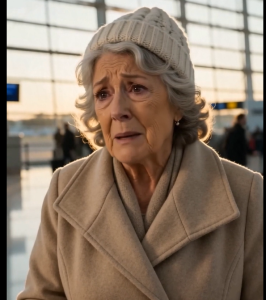
At Gate 32, the morning crowd moved. Suitcases rolled over polished floors. Coffee cups steamed in impatient hands. A baby cried near the windows, travelers kept glancing at the departure screen.
Near the boarding lane stood an elderly woman in a faded brown coat. She was small, with silver hair tucked carefully beneath a knit scarf, and both of her hands held one boarding pass as though it might blow away. The paper had been printed in large letters by someone at home who must have known she did not see as well as she once had. The corners were bent from being folded and unfolded too many times.
Her shoes were worn thin at the edges. Her handbag was plain and old-fashioned. There was nothing about her that suggested first class, special treatment, or importance. She looked like a grandmother who had packed carefully and arrived early because she feared making a mistake.
When her row was called, she stepped forward with a shy smile.
The gate agent scanned her ticket. The machine made a harsh sound.
The agent frowned, tapped the screen, and scanned it again. The same sound followed.
“You can’t board yet, ma’am,” she said, her voice sharp enough to turn a few heads. “There’s an issue with your ticket.”
The old woman blinked. “An issue?”
“Yes,” the agent said. “Please step aside.”
The woman moved out of the lane, embarrassed before anyone had accused her of anything. She clutched the boarding pass closer to her chest. “I’m only going to visit my son,” she said softly. “He has been flying for years. I promised him I would come today.”
The agent did not look up. “I understand, but the system is flagging your ticket.”
Behind them, passengers began to shift. Someone sighed loudly. A man in a navy suit checked his watch and shook his head. A woman pulling a silver carry-on whispered, “There’s always somebody holding up the line.”
The old woman heard it. Her face tightened, but she said nothing.
“I bought the ticket,” she said, almost apologizing. “I saved for it. My neighbor helped me print everything.”
The agent exhaled like patience was running out. “Ma’am, I’m not saying you didn’t buy it. I’m saying you cannot board until this is cleared.”
The elderly woman nodded, though she clearly did not understand. She stepped farther from the line, leaving enough room for others to pass. One by one, travelers scanned their passes and walked through the jet bridge. Some stared at her. Others avoided her eyes, as people often do when someone else’s humiliation is happening in public.
Minutes passed.
She kept looking toward the plane. Through the glass, she could see the aircraft waiting in the pale morning light. It was larger than anything she had ever imagined being inside. Today, after years of quiet wishing, one of those blue seats was finally supposed to be hers.
The agent picked up the phone, spoke briefly, then hung up.
“Please wait,” she said.
“I am waiting,” the woman answered gently.
The final passengers were nearly through when the intercom crackled above the gate.
“Captain requested at Gate 32.”
The words were ordinary, but they changed the air.
A moment later, the cockpit door opened at the end of the jet bridge. A tall pilot in a crisp uniform stepped out. His hat was tucked under one arm, and the gold stripes on his shoulders caught the light. He walked quickly toward the counter, ready to solve whatever problem had delayed his flight.
Then he saw her.
He stopped so suddenly that the agent looked up.
The pilot’s face changed. The authority left it first, then the professionalism, then the practiced calm. What remained was something younger, stunned, and deeply human.
“Mama?” he said.
The gate went silent.
The elderly woman turned toward the sound of his voice. For one second, she did not move. Then her lips trembled.
“My son,” she whispered.
The pilot crossed the gate in long strides. He did not seem to notice the passengers, the agent, or the phones already rising in the air. He knelt in front of the old woman as if the airport floor were the most natural place in the world for a captain to be. Then he wrapped his arms around her and held her tightly.
She touched his face with both hands, as though she needed to prove he was real.
“This flight doesn’t leave,” he said, his voice breaking, “without my mother.”
The agent’s color faded. “Captain, I’m sorry. The system flagged her ticket. We were just trying to verify—”
“The system is wrong,” he said calmly, but every word carried weight. “She is cleared.”
“But, sir—”
He stood, still keeping one hand under his mother’s elbow. “She bought that ticket with money she saved for two years.”
The crowd stirred. The annoyed whispers changed into something softer. People who had been irritated a minute earlier now lowered their eyes.
The pilot turned slightly, not making a speech exactly, but speaking loud enough that no one had to strain to hear.
“When my father died, she sold vegetables in the market so I could stay in school,” he said. “She woke before sunrise and came home after dark. When I failed my first flight exam, I was ready to quit. She told me, ‘A fall is not the end of a journey unless you decide to stay on the ground.’”
The old woman wiped her cheek with the back of her hand.
“She believed in a future I could not see,” he continued. “I promised her that one day, when I became a pilot, she would fly with me. Not just on any plane. On mine.”
No one complained now.
The agent looked down at the boarding pass. Her hands moved more carefully this time. She typed, waited, then stamped the document.
“You’re cleared to board, ma’am,” she said, her voice much softer.
The old woman nodded. “Thank you.”
The pilot took the boarding pass and placed it gently back in his mother’s hand. Then he offered his arm.
She held it proudly, standing taller.
As they walked toward the jet bridge, the passengers began to clap. At first it was only one person near the windows. Then another joined. Then the sound spread through the gate until applause filled the space where impatience had been.
Inside the plane, the pilot helped his mother to her seat himself. He adjusted the belt, placed her bag safely above, and leaned down.
“You made it, Mama,” he said.
She smiled through tears. “No,” she whispered. “We made it.”
A few minutes later, his voice came over the cabin speakers.
“Ladies and gentlemen, thank you for your patience. Today’s flight carries a very special passenger. She is the woman who worked, sacrificed, and believed long before I wore this uniform. She is my greatest honor.”
The cabin answered with warm applause.
The old woman looked out the window as the plane began to move. For the first time in her life, the ground slipped away beneath her. But she was not simply a passenger that day.
She was the reason everyone had waited.