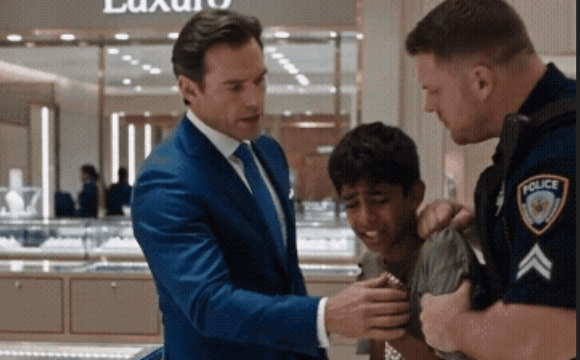
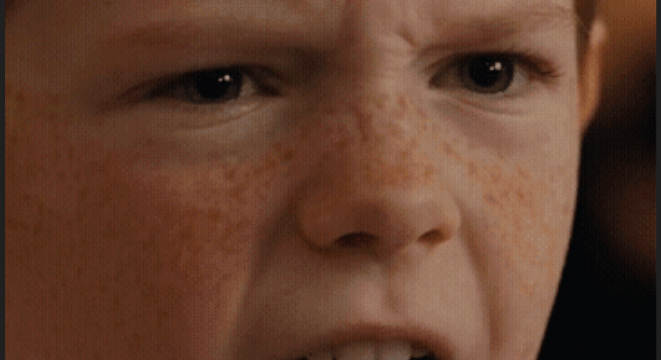
They mocked a little boy for believing his mother was a soldier. Then the sirens screamed, the classroom windows shook, and a Black Hawk landed on the school field with the truth no one could deny.
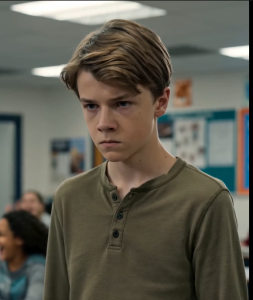
The classroom was filled with excitement. It was show-and-tell Friday, and everyone had brought something that proved their families were important. Tyler set his father’s law firm trophy on the table. Sarah passed around a silk scarf her mother had brought back from a fashion show in Paris. When Mrs. Higgins called my name, I stood slowly. My hands were empty. I had nothing wrapped in tissue paper, nothing polished, nothing expensive. Still, I swallowed hard and told the truth.
“My mom is a Specialist in the Army,” I said. “She has been away for eighteen months on a special mission, and she told me she would be home today.”
For one second, nobody moved. Then Tyler gave a loud whistle that cut through the room like a slap. “Come on, Leo,” he said, leaning back in his chair with a grin. “You said that last year. You said it the year before, too. My dad says your mom probably just left because she didn’t want to deal with your grades. If she were really a soldier, you would have a uniform, or a medal, or at least a picture. You’ve got nothing.”
A few kids laughed right away. Others looked at Mrs. Higgins. Her face softened into a smile that was supposed to be kind, but it hurt worse than Tyler’s words. “Leo, honey,” she said gently, “we have talked about using our imagination. It is all right if your mother works at a store, or if things at home are difficult. You do not have to invent stories to keep up with everyone else.”
Heat rushed into my face. “I am not lying,” I said, louder than I meant to. “She is coming. She promised.”
That was when the whole class began to laugh. Someone whispered, “Liar.” Another voice turned it into a chant. “Liar, liar.” Even Principal Grant passed by the open door, glanced in, and shook his head. To them, I was just the boy with the worn backpack and the missing mother, the boy who needed a fantasy because the truth was too sad to say. I sat down, fighting tears.
Then the windows trembled.
At first, the sound was low and far away, a steady thump, thump, thump that seemed to rise through the floorboards. The laughter weakened. Pencils rolled across desks. The fluorescent lights flickered. The thumping grew louder until it became a roar. Outside, the bright playground suddenly darkened, as if a storm cloud had dropped from the sky.
The school sirens screamed.
Mrs. Higgins ran to the window. Her clipboard slipped from her hand and scattered papers across the floor. “Oh my goodness,” she whispered.
Every child rushed to the glass. I stood frozen for a heartbeat, because somewhere inside that roar, I knew. On the soccer field behind the school, a Black Hawk helicopter was coming down. Its blades tore circles through the air, flattening the grass and driving dust against the brick building. Police cars lined the curb with lights flashing, and deputies were moving people back from the field. It was not an emergency drill. It was an arrival.
Mrs. Higgins turned toward me, her face pale. “Leo,” she said, barely able to speak, “is that for you?”
I did not answer. I was already running.
I pushed through the emergency door and out into the wind thrown off by the helicopter. My shirt snapped against my chest, and the noise swallowed every shout behind me. The side door slid open. Three soldiers in full gear stepped down first, scanning the field with practiced focus. Then a fourth figure appeared in the doorway.
She jumped to the ground with a heavy, certain step.
My mother wore camouflage fatigues, dusty boots, and a beret tucked under one shoulder strap. Ribbons lined her chest, catching flashes of sun through the blowing grit. Her face looked thinner than I remembered, and there were tired lines near her eyes, but when she saw me, her whole expression changed. For the first time in eighteen months, the distance between us disappeared.
“Mom!” I shouted.
Before I could reach her, Principal Grant and Sheriff Collins hurried onto the field. They stopped several feet away and snapped into a salute. “Major Miller,” the sheriff called over the slowing rotors. “Welcome home. We received the Pentagon notice this morning.”
Major. Not make-believe. Not grocery store. Not a story I had created to hide my pain.
Behind me, doors burst open. Students, teachers, and parents poured onto the sidewalk. Tyler’s father, still in his suit from work, stared at my mother’s uniform. His confident lawyer’s smile disappeared as his eyes moved over her rank, her ribbons, and the badge on her chest. Tyler stood beside him, pale and silent.
My mother did not look at them first. She dropped her rucksack and knelt in the grass, opening her arms. I ran so hard I nearly knocked her over. She held me against her, and I breathed in the smell of dust, engine oil, and home.
“I told you I would come for show-and-tell,” she whispered near my ear. “Did I miss my turn?”
I shook my head, unable to speak.
She rose with one hand resting firmly on my shoulder and walked me toward the stunned crowd. The silence felt bigger than the helicopter. Mrs. Higgins stepped forward, trembling. “Major, I am so sorry. We did not understand. Leo said you were a specialist, and I thought…”
“Special Forces,” my mother corrected calmly. Her voice was not angry, but it carried the authority of someone who had stood in harder places than a schoolyard. “I have been coordinating a joint task force overseas. I apologize for the dramatic entrance. The White House briefing ran late, and I had a very important appointment with my son.”
No one laughed. No one whispered. Even the younger children seemed to understand that the truth had landed in front of them with steel blades and military orders.
My mother reached into her pocket and took out a small velvet box. She did not hand it to the teacher or the principal. She handed it to me. “Since I could not give Leo anything to bring today,” she said, “I brought this myself. It is the Distinguished Service Cross. It belongs to our family now.”
The medal felt heavy in my palm, heavier than anything Tyler had placed on that table. It was not just metal. It was eighteen months of waiting, every lonely dinner, every unanswered question, every morning I had walked into school believing a promise no one else believed.
I looked at Tyler. His face was red, but not from laughter anymore. He stepped back, making room for us, and his father lowered his eyes.
My mother turned to Principal Grant. “I believe my son is excused for the rest of the day,” she said. “We have eighteen months of catching up to do.”
As we walked toward the parking lot, the helicopter rose behind us, its roar rolling over the playground like a final salute. I never said, “I told you so.” I did not need to. My mother’s boots on that grass had already said everything.